List Of Central and State Government Schemes for Women’s Self-Help Groups in India
Every women’s self help group scheme in India comes with real money — grants, subsidised loans, and skill support. Yet most SHG members don’t know which scheme gives what.
This guide lists every major central and state government scheme with exact financial details, in plain language.
Women’s Self-Help Group Scheme – Key Numbers at a Glance
What is a Women’s Self-Help Group in India?
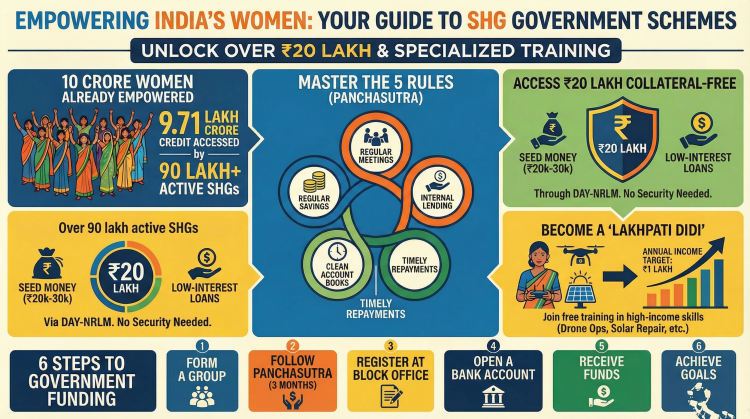
A women’s self-help group is 10 to 20 women from similar backgrounds who save together, lend to each other, and run income-generating activities as a team. Any SHG seeking government aid must follow the Panchasutra — five rules
- Regular meetings
- Regular savings
- Internal lending
- Timely repayment
- Keep clean account books
Here’s a focused eligibility section that fits naturally into your article:
What are the Eligibility Criteria for Women’s Self-Help Group Schemes in India?
To qualify for government support under schemes like DAY-NRLM, DAY-NULM, or the SHG-Bank Linkage Programme, your group must meet the following requirements.
Member-Level Eligibility for Women’s Self Help Group Schemes in India
- Be a woman aged 18 years or older. Some state programs set the minimum age at 21.
- Live in the same village or urban ward as the other members of your group.
- Come from a low-income or BPL household, as identified through the Socio-Economic Caste Census (SECC) 2011 data.
- Have only one member per household. Only one woman from each family can join a government-supported SHG.
- Not be an active member of another government-funded SHG. Duplicate membership across funded groups is not allowed.
Group-Level Eligibility for Women’s Self Help Group Schemes in India
- Have between 10 and 20 members. Groups in hilly, tribal, or remote areas may be allowed as few as 5 members.
- Be registered with local authorities, such as your Block Mission Management Unit (BMMU) or under the relevant state act.
- Hold regular meetings and maintain a proper meeting register with attendance and decisions recorded.
- Follow the Panchasutra principles — regular meetings, regular savings, regular internal lending, timely repayment, and proper bookkeeping.
- Operate a joint bank account in the SHG’s name, managed by at least two office bearers.
- Be active for at least 3 to 6 months before applying for external funding or bank loans.
Who Gets Priority for Women’s Self Help Group Schemes in India?
While any eligible women’s group can apply, government schemes give extra preference to groups that include women from these backgrounds:
- Scheduled Castes (SC) and Scheduled Tribes (ST)
- Other Backward Classes (OBC) and minority communities
- Women living below the poverty line (BPL)
- Widows and single women
- Women with disabilities
- Survivors of domestic violence or trafficking
- Women in LWE-affected or remote tribal districts
Eligibility conditions may vary by state and scheme. Check with your local Block Development Office (BDO) or District Mission Management Unit (DMMU) for the latest requirements.
What are the Top Central Government Schemes Supporting Women Self-Help Groups with Financial aid details
1. DAY-NRLM — The Biggest Women’s Self Help Group Scheme in India
Run by the Ministry of Rural Development, DAY-NRLM is the flagship women’s self help group scheme that connects rural poor women with banks, training, and capital.
What you get:
- Revolving Fund (seed money): ₹20,000 – ₹30,000 per SHG
- Community Investment Fund: Up to ₹2.5 lakh per SHG
- Bank loan at 7% interest: Up to ₹3 lakh
- Bank loan at MCLR rate: ₹3 lakh – ₹5 lakh
- Collateral-free loan: Up to ₹20 lakh
- Prompt repayment bonus: Interest drops to 4%
Official Website: nrlm.gov.in
How to apply: Contact your Block Resource Centre (BRC), visit nrlm.gov.in, or go to your district Collectorate.
2. NABARD SHG Bank Linkage Programme
NABARD’s SHG Bank Linkage Programme, running since 1992, connects women’s self help groups directly to banks — no complicated paperwork, no middlemen.
What you get:
- ₹1,500 grant to SHG promoters per group formed
- Free Micro Enterprise Development Programme (MEDP) training for matured SHGs
- Access to the full national bank credit pool of ₹9.71 lakh crore
Official Website: nabard.org
How to apply: Walk into any public sector bank, Regional Rural Bank, or cooperative bank. Ask to open an SHG savings account and start the bank linkage process.
3. PM MUDRA Yojana — Loans for SHG Members
PM MUDRA Yojana gives business loans to individual members of women’s self-help groups — no collateral, no guarantor.
What you get:
- Shishu loan: Up to ₹50,000
- Kishore loan: ₹50,001 – ₹5 lakh
- Tarun loan: ₹5 lakh – ₹10 lakh
- Under the MUDRA–DAY-NRLM link: Up to ₹1 lakh per SHG member
Official Websites: mudra.org.in and udyamimitra.in
How to apply: Apply at any bank or NBFC. Online: udyamimitra.in. Carry your Aadhaar, SHG membership proof, and a basic business plan.
4. Mission Shakti — STEP Programme
Mission Shakti’s STEP (Support to Training and Employment Programme) connects women’s self help group members to skill training and direct market access.
What you get:
- Free skill training in handloom, fisheries, agriculture, leather goods
- Stipend during training
- Market linkage after training completion
Official Website: Mission Shakti
How to apply: Contact your State Women and Child Development Department or a local NGO empaneled under Mission Shakti.
5. Lakhpati Didi — ₹1 Lakh Annual Income Target
Lakhpati Didi is a women’s self help group scheme that trains active DAY-NRLM SHG members to earn at least ₹1 lakh per year through non-traditional, high-income skills.
What you get:
- Free training in drone operation, LED repair, plumbing, solar servicing
- Government target: 3 crore Lakhpati Didis by 2024–25
- Stipend in select states during training
Official Website: nrlm.gov.in (under DAY-NRLM portal)
How to apply: Contact your Village Organization (VO) or Cluster Level Federation (CLF) under DAY-NRLM.
6. Start-up Village Entrepreneurship Programme (SVEP)
SVEP is a DAY-NRLM sub-scheme that funds women’s self help group members and their families to launch small non-farm enterprises, with hand-holding support for up to 18 months.
What you get:
- Soft loans and revolving fund for business setup
- 6–18 months of free guidance from Community Enterprise Promoters
- 3.13 lakh enterprises supported as of October 2024
Official Website: nrlm.gov.in/SVEP (under DAY-NRLM portal)
How to apply: Talk to your Block Resource Centre (BRC). Community Enterprise Promoters (CEPs) guide the process at no cost.
You May Like
- Government Schemes for Female Entrepreneurs in India
- Majhi Ladki Behan Yojana Maharashtra – Benefits, Eligibility & How to Apply
- Top 8 Central Government Schemes For Housewives
- Subhadra Yojana Scheme – Complete Guide
What are the Top State Government Schemes for Women’s Self Help Groups?
Kerala — Kudumbashree
Kudumbashree is India’s most successful women’s self help group scheme at the state level, with over 45 lakh members across Kerala since 1998.
What you get:
- Pooled savings and bank loans through Thrift and Credit Societies
- Direct market access: government canteens, schools, hospitals
- Support for urban farming and micro-enterprise clusters
Official Website: kudumbashree.org
How to apply: Visit your nearest Kudumbashree district office or local Panchayat office.
Andhra Pradesh — SERP Model
The Society for Elimination of Rural Poverty (SERP) runs the world’s largest women’s self help group network in Andhra Pradesh through a three-tier SHG–VO–Mandal Samakhya structure.
What you get:
- 1.2 lakh+ active SHGs with bank linkages
- Livelihood support in agriculture, dairy, aquaculture
- Zero-interest loans under select state programmes
Official Website: serp.ap.gov.in
How to apply: Contact your Mandal Parishad office or SERP district office. Telangana women contact TSERP through their Village Organisation at tserp.telangana.gov.in
Tamil Nadu — TNSRLM
Tamil Nadu’s women’s self help group scheme runs through TNSRLM with additional state top-ups on interest subvention, cutting loan costs further than the central scheme alone.
What you get:
- State interest subvention on top of the central 7% rate
- Makkal Marumalarchi SHG Bazaar for product sales
- Free skill training through TNSRLM district units
Official Website: Tamil Nadu State Rural Livelihoods Mission
How to apply: Visit your Block office and ask for the TNSRLM coordinator.
Maharashtra — MAVIM
MAVIM (Mahila Arthik Vikas Mahamandal) runs Maharashtra’s women’s self help group scheme for both urban and rural women, including tribal communities.
What you get:
- Bank and MFI-linked loans
- Access to SARAS Fairs and government procurement tenders
- Tejaswini programme for rural women entrepreneurs
Official Website: mavim.maharashtra.gov.in
How to apply: Visit the MAVIM district office or your Zilla Parishad women’s development office.
Assam — MMAUA
The Mukhya Mantri Udyog Abhijan Assam (MMAUA) gives direct capital to women’s self help group members and women entrepreneurs across Assam.
What you get:
- Capital support: ₹10,000 – ₹50,000 per enterprise
- Interest-free loan for women graduates: Up to ₹2 lakh
- 4 lakh+ rural women already benefited
Official Website: Assam Mukhyamantri Mahila Udyamita Abhiyan
How to apply: Apply at assam.gov.in or visit your district SRLM office. Carry Aadhaar, income certificate, and residential proof.
Quick Comparison: All Women’s Self-Help Group Schemes
| Scheme | Run By | Key Financial Aid |
|---|---|---|
| DAY-NRLM | Central Govt | ₹20K–₹30K seed + ₹2.5L CIF + 7% loans to ₹3L |
| NABARD SHG-BLP | NABARD | Free MEDPs; ₹1,500 to promoters; full bank access |
| PM MUDRA Yojana | Central Govt | Loans ₹50K to ₹10L; no collateral |
| Mission Shakti STEP | Ministry of WCD | Free training + stipend + market linkage |
| Lakhpati Didi | Central Govt | Free skills; target ₹1L/year income |
| SVEP | Central Govt | Soft loans + 18 months hand-holding |
| Kudumbashree | Kerala Govt | Bank loans + direct market access |
| SERP (AP) | AP Govt | Zero-interest loans + livelihood support |
| TNSRLM | Tamil Nadu Govt | State subvention + SHG Bazaar |
| MAVIM | Maharashtra Govt | Bank loans + SARAS Fairs |
| MMAUA | Assam Govt | ₹10K–₹50K capital; ₹2L interest-free |
How to Form an SHG and Get Government Money — 6 Steps
Step 1 — Form your group. Gather 10–20 women with similar economic backgrounds. Agree on a fixed weekly or monthly savings amount.
Step 2 — Follow the Panchasutra. Hold regular meetings, maintain a savings register, lend internally, repay on time, and keep proper accounts.
Step 3 — Register. After 3–6 months of savings, register with your Block Resource Centre (BRC) under DAY-NRLM.
Step 4 — Open a bank account. Open a joint SHG savings account at any public sector bank or Regional Rural Bank. Bring your group resolution letter, member list, and Aadhaar of all members.
Step 5 — Get your Revolving Fund. After 3 months of good performance, apply for ₹20,000–₹30,000 in seed money under DAY-NRLM.
Step 6 — Apply for a bank loan. After 6 months, apply for an SHG bank loan. Pay just 7% interest — or 4% if you repay on time. No collateral needed up to ₹20 lakh.
Documents needed: Aadhaar (all members), bank account proof, SHG registration certificate, savings register, meeting minutes, BPL card if applicable.
Read: Link Mobile Number with Aadhaar Card: Process, Charges
FAQs on Women’s Self Help Group Schemes
What is the maximum loan a women’s SHG can get?
Under DAY-NRLM, an SHG can get up to ₹20 lakh without collateral. Under PM MUDRA, individual members can borrow up to ₹10 lakh for a business.
Do SHGs receive money directly from the government?
Yes. The Revolving Fund and Community Investment Fund go directly into the SHG’s bank account. Interest subvention is credited to the bank on the SHG’s behalf.
Can urban women join SHG schemes?
Yes. DAY-NULM (National Urban Livelihoods Mission) runs a parallel women’s self help group scheme for urban women at mohua.gov.in. Kudumbashree and MAVIM also actively support urban SHGs.
Who qualifies for Lakhpati Didi?
Any active member of a DAY-NRLM-registered SHG qualifies. Training is free and targets ₹1 lakh in annual income per woman. More at nrlm.gov.in.
How to form a women’s self-help group in a rural area?
Your group needs 10–20 women members, all aged 18 or above and from low-income or BPL households. The group must be registered, have a bank account, and maintain records of meetings, savings, and loans for at least 3–6 months.
Women from SC/ST communities or with no regular income get priority in many schemes. Criteria can vary by state, so check the full scheme list for details.
How can I join a women’s self-help group scheme near me?
Visit your nearest Gram Panchayat, Anganwadi centre, or Block Development Office and ask about active SHGs in your area.
You can also contact your state’s Rural Livelihoods Mission — like Kudumbashree in Kerala or Jeevika in Bihar — through their helpline or website.
If no group exists near you, you can start one yourself. Block-level helpers are available to guide you at no cost.
What are the steps to register a new self-help group for women’s empowerment?
Follow these four steps:
Step 1: First, form the group and hold at least 3 meetings with written records.
Step 2: Open a joint savings account at a bank or post office.
Step 3: Prepare basic rules for your group covering savings, meetings, and penalties.
Step 4: Visit your Block Development Office or state SRLM with the member list, group resolution, and bank details.
Some states also let you register under the Societies Registration Act, which unlocks bigger grants and loans.
What are the financial assistance options available for women’s SHGs in India?
New SHGs can get a Revolving Fund of ₹10,000–₹15,000 under DAY-NRLM, and up to ₹2.5 lakh through the Community Investment Fund.
The SHG-Bank Linkage Programme gives collateral-free loans starting at ₹1–3 lakh. Mudra Yojana offers loans up to ₹10 lakh for small businesses.
NRLM’s Interest Subvention Scheme caps loan interest at 7%. See the full breakdown of the schemes for more details.
Where to find local government offices assisting women’s self-help groups?
Start with your Block Development Office (BDO) — most SHG registrations and funds flow through here. The District Rural Development Agency (DRDA) handles NRLM at the district level. Anganwadi centers and Common Service Centers (CSCs) can also point you in the right direction.
For cities, contact your Municipal Corporation’s women and child welfare department. In most cases, a visit to your Gram Panchayat is the easiest first step.
The Bottom Line
A well-run women’s self help group can access ₹20,000 in seed money at formation and scale up to ₹20 lakh in bank credit — all at subsidised rates with no collateral. The process starts with discipline: form the group, follow the Panchasutra, open a bank account, and register with your BRC.
Disclaimer: Financial figures are based on official data from NABARD, Ministry of Rural Development, and state government sources as of February 2025. Scheme amounts may be revised annually. Always verify current details at the official websites listed above or with your nearest BRC before applying.
Note from the Editor: The Current India tracks every update to women’s self-help group schemes, welfare schemes, budgets, and policy changes so you always have accurate information. Share this guide with women in your community who need it.
Interesting Read
- Top 8 Government Scheme for Startups in India – Complete Guide
- Are There Government Schemes Providing Free Digital Literacy Courses in India?
- EV Subsidy in India – Which Government Schemes Offer Subsidies for Electric Vehicle Buyers in India?
- Top Government Subsidy for Solar Panels in India – Complete Guide for Homeowners
- What Are Government-Backed Home Loans for First-Time Buyers in India Complete Guide
- Central Government Health Scheme Card (CGHS) – Eligibility, How to Download and Apply
- PM Kaushal Vikas Yojana: PMKVY, Free Skill Training Mission
- UDAN Scheme: Airport and Airlines List
