MSME Support – Which Central Government Schemes Offer Direct Financial Support for Small Business Owners in India?
Lack of timely MSME support and access to affordable finance remains one of the biggest challenges for small business owners in India.
To address this gap, the Government of India has launched multiple central government schemes that offer direct financial support in the form of collateral-free loans, capital subsidies, credit guarantees, and reimbursement-based incentives.
So, which Central Government Schemes Offer Direct Financial Support for Small Business Owners in India? The MSME support schemes listed below are implemented through official ministries, public sector banks, or government agencies—making this article authoritative, reliable, and actionable for business owners, lenders, and policy researchers.
MSME Support – Top Central Government Schemes Offering Direct Financial Support
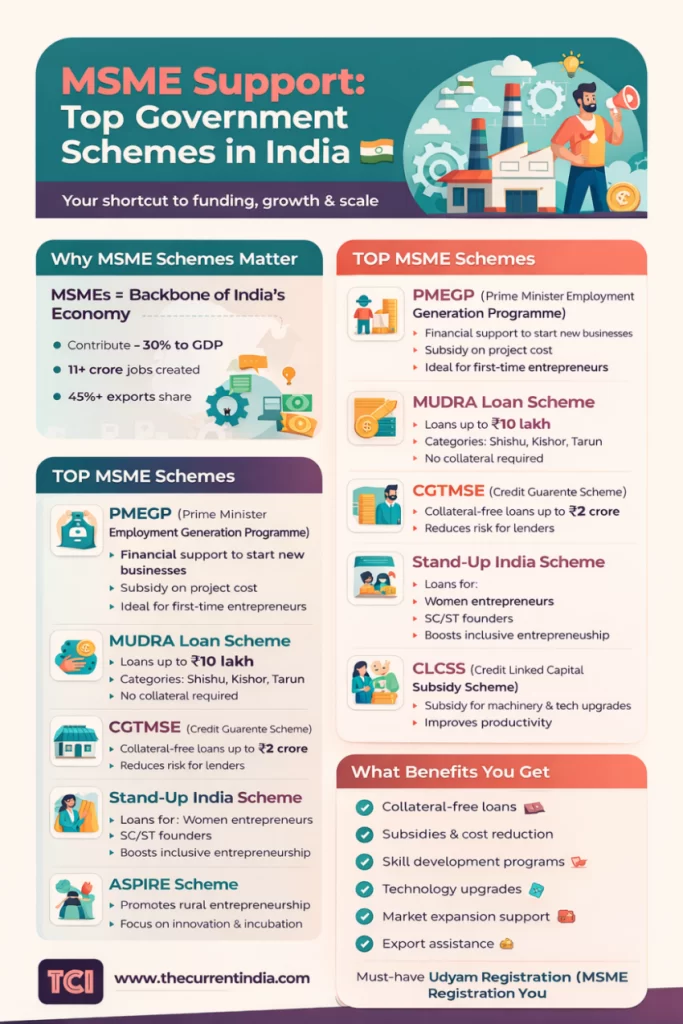
The major central government schemes that provide direct financial support to small business owners in India include:
Snapshot of Central Government Schemes
| Scheme | Type of Support | Financial Limit | Target Beneficiaries |
| MUDRA (PMMY) | Collateral-free loans | Up to ₹10 lakh | Micro & small enterprises |
| PMEGP | Margin money subsidy | 15–35% | New entrepreneurs |
| PM SVANidhi | Working capital loans | ₹10,000+ | Street vendors |
| Stand-Up India | Composite loans | ₹10 lakh–₹1 crore | Women & SC/ST |
| CLCSS | Capital subsidy | 15% (capped) | Manufacturing MSMEs |
| CGTMSE | Credit guarantee | As per bank norms | MSMEs |
| PCR Scheme | Fee reimbursement | Partial | Registered MSMEs |
7 Central Government Schemes Offer Direct Financial Support for Small Business Owners in India – A Deep Dive
1. Pradhan Mantri MUDRA Yojana (PMMY)
Type of support: Collateral-free business loans
Loan limits:
- Shishu: up to ₹50,000
- Kishor: ₹50,001 – ₹5 lakh
- Tarun: ₹5 lakh – ₹10 lakh
The Pradhan Mantri MUDRA Yojana enables micro and small entrepreneurs to access unsecured working capital and term loans through banks, NBFCs, and microfinance institutions.
The scheme targets non-corporate, non-farm enterprises, including traders, service providers, and small manufacturers.
Best suited for:
First-time entrepreneurs, sole proprietors, micro businesses
2. Prime Minister’s Employment Generation Programme (PMEGP)
Type of support: Margin money subsidy (government grant)
Subsidy levels:
- Urban areas: 15%–25% of project cost
- Rural areas: 25%–35% of project cost
PMEGP provides direct capital subsidy to entrepreneurs establishing new micro enterprises in manufacturing or services. The subsidy is adjusted against the sanctioned bank loan, reducing the entrepreneur’s repayment burden from day one.
Best suited for:
New businesses, rural entrepreneurs, first-generation founders
Read: PMEGP eligibility criteria and project cost limits
3. PM Street Vendor’s AtmaNirbhar Nidhi (PM SVANidhi)
Type of support: Micro working-capital loans
Loan size:
Starting from ₹10,000 with eligibility for higher repeat tranches
PM SVANidhi supports urban street vendors by offering quick-access working capital loans. Timely repayment unlocks higher loan limits, interest subsidies, and digital payment incentives, improving both liquidity and formal credit access.
Best suited for:
Street vendors, hawkers, urban self-employed workers
4. Stand-Up India Scheme
Type of support: Composite bank loans
Loan amount: ₹10 lakh – ₹1 crore
The Stand-Up India Scheme promotes entrepreneurship among women and SC/ST entrepreneurs by facilitating bank loans for greenfield projects in manufacturing, services, or trading.
Best suited for:
Women founders and SC/ST entrepreneurs planning medium-scale businesses
5. Credit Linked Capital Subsidy Scheme (CLCSS)
Type of support: Capital subsidy for machinery
Subsidy:
15% of eligible machinery cost (subject to scheme caps)
CLCSS reduces the cost of technology upgradation for micro and small manufacturing enterprises by offering an upfront capital subsidy through lending institutions.
Best suited for:
Manufacturing MSMEs upgrading plant or machinery
6. Credit Guarantee Scheme (CGTMSE)
Type of support: Credit guarantee for collateral-free loans
CGTMSE enables banks to provide loans without collateral by offering a government-backed credit guarantee. While no cash is paid directly to entrepreneurs, the scheme significantly improves loan approval chances.
Best suited for:
Businesses lacking collateral or third-party guarantees
7. Performance & Credit Rating Scheme (NSIC)
Type of support: Reimbursement of credit rating fees
This scheme reimburses part of the cost incurred by MSMEs to obtain a formal credit rating, helping them secure larger loans and better interest rates from banks.
Best suited for:
MSMEs seeking improved creditworthiness
Internal link suggestion:
👉 Benefits of MSME credit ratings for loan approvals
Application Checklist for Government Financial Support Schemes
Before applying, ensure you have:
- Udyam Registration Certificate
- PAN and Aadhaar (business and promoter)
- Business bank account statements (6–12 months)
- Basic project report or business plan
- Category certificate (SC/ST/Woman), if applicable
- Vendor certificate (for PM SVANidhi)
Download the one-page PDF summary with application checklist
Conclusion
India’s central government offers multiple financial support schemes that directly address the funding needs of small businesses, from startups to established MSMEs.
By choosing the right scheme—whether for working capital, subsidies, or credit support—entrepreneurs can reduce financing barriers and lower costs.
Proper Udyam registration and documentation are key to accessing these benefits. Used strategically, these schemes can significantly accelerate sustainable business growth.
Government Support Schemes For MSMEs – FAQs
Can startups with prior govt funding apply for SISFS?
No, startups that have received more than ₹10 lakh government funding are ineligible for SISFS but may apply for others like Mudra.
Are collateral-free loans available in all schemes?
No, PMMY and CGTMSE specifically offer collateral-free loans; others may require margins or guarantees.
Is business turnover or experience mandatory?
Most schemes do not require turnover; some like Mudra prefer operational history, and PMEGP requires minimum education for larger loans.
What documents are typically needed?
Aadhaar, PAN, business registration, photographs, project report, and sometimes educational proofs are mandatory.
Does educational qualification affect eligibility?
Yes, PMEGP requires 8th pass for bigger projects; others mostly do not have minimum educational criteria
Source: Press Release:Press Information Bureau
You May Also Like
- Top Corporate And Government Job Portals In India
- Telangana Government Schemes
- Full List Of Karnataka Government Schemes
- Government Schemes for Female Entrepreneurs in India – Guide to Loans, Subsidies and Start-Up Support
- EV Subsidy in India – Which Government Schemes Offer Subsidies for Electric Vehicle Buyers in India?
