Which Government Schemes Provide Free or Subsidized Education for College Students?
TL;DR
→	India runs over a dozen central schemes that pay tuition, hostel costs, or loan interest for college students — not just school children.
→	Scholarships (CSSS, Pragati, Saksham, Post-Matric, Top Class Education) hand out cash for fees, books and laptops. You don’t repay this money.
→	Loan schemes (PM-Vidyalaxmi, CSIS) don’t waive fees — they cut or remove the interest on education loans up to ₹10 lakh.
→	Almost every central scheme routes through one portal: scholarships.gov.in (NSP). One registration unlocks several schemes.
→	Income limits range from ₹1 lakh to ₹8 lakh a year depending on the scheme — always check the current cap before applying.
Want to know which Indian government schemes pay for, or cut the cost of, college education, who qualifies, how much you get, and where to apply. No school-level schemes, no general welfare programmes. Just the ones that matter once you’re in college.
The cost of education has climbed faster than most family incomes in the last decade. The government’s response has been to run two kinds of support: money that doesn’t need to be repaid, and money that reduces what you repay on a loan. Both are real, both are active right now, and most of them run through one common portal. Here’s the full picture.
Two Ways the Government Pays for Your College Education
Every scheme below falls into one of three buckets. Knowing which bucket you need saves you from chasing the wrong application.
- Scholarships and grants — direct cash for fees, books, hostel or a laptop. You never pay this back.
- Loan interest subsidies — the loan itself isn’t free, but the government pays or waives the interest, sometimes fully, during your study period.
- Outright fee waivers — a handful of state governments simply don’t charge tuition to specific categories of students in government colleges.
Central Government Scholarship Schemes for College Students
These are the flagship scholarships run by central ministries. Every one of them is processed through the National Scholarship Portal (NSP) — scholarships.gov.in.
| Scheme | Who It’s For | What You Get | Income Cap |
| Central Sector Scheme of Scholarship (CSSS / PM-USP) | UG/PG students who scored 80+ percentile in Class 12 boards | ₹12,000/yr (UG, first 3 yrs); ₹20,000/yr (PG) | ≤₹4.5 lakh |
| AICTE Pragati Scholarship | Girls in AICTE-approved technical diploma/degree courses (max 2 per family) | ₹50,000/year via DBT | ≤₹8 lakh |
| AICTE Saksham Scholarship | Students with 40%+ disability in technical courses | ₹50,000/year via DBT | ≤₹8 lakh |
| AICTE Swanath Scholarship | Orphans, or students whose parent died or is severely disabled | ₹50,000/year via DBT | ≤₹8 lakh |
| Post-Matric Scholarship for SC/ST Students | SC/ST students in recognised colleges | Tuition fees + maintenance allowance (varies by state) | Set by ministry; check NSP |
| Top Class Education Scheme (OBC/EBC/DNT) | Meritorious OBC/EBC/DNT students admitted to premier institutes | Full tuition up to ₹2 lakh/yr + hostel ₹3,000/month + books ₹5,000/yr + one-time laptop grant up to ₹45,000 | ≤₹2.5 lakh (OBC/DNT); ≤₹1 lakh (EBC) |
| Pre-Matric & Post-Matric Scholarship for Minorities | Muslim, Christian, Sikh, Buddhist, Jain and Parsi students | Tuition + maintenance allowance (amount varies by class/state) | Set by ministry; check NSP |
Note: A student can usually claim only one central scholarship at a time — picking the one with the highest benefit for your category is the smarter move.
Government Education Loan Schemes That Cut Your Interest Bill
If you don’t qualify for a fee waiver, these schemes make borrowing for college cheaper — sometimes interest-free during your study years.
- PM-Vidyalaxmi Scheme — a single portal (pmvidyalaxmi.co.in) for collateral-free, guarantor-free loans up to ₹10 lakh for admission into 860+ Quality Higher Education Institutions. A 3% interest subvention applies if family income is up to ₹8 lakh a year. Approved by the Cabinet in November 2024 and fully operational in 2026.
- Central Sector Interest Subsidy Scheme (CSIS) — a 100% interest subsidy during the moratorium period (course duration plus one year) on loans up to ₹10 lakh, for families earning up to ₹4.5 lakh a year. It now runs through the PM-Vidyalaxmi portal.
- Credit Guarantee Fund Scheme for Education Loans (CGFSEL) — the government guarantees 75% of the loan amount if a student defaults, and caps the interest banks can charge at base rate plus 2%. It applies to professional and technical courses in India and is run through the National Credit Guarantee Trustee Company.
Scheme watch: the Padho Pardesh interest subsidy for minority students studying abroad was discontinued from FY 2022-23. If you’ve seen it listed elsewhere, that listing is outdated — only students sanctioned before 31 March 2022 still receive the subsidy.
Outright Fee Waivers Run by State Governments
Beyond central schemes, several states fund tuition directly for students in their own government colleges. These don’t run through NSP — you apply through your state’s higher or technical education department.
- States such as Tamil Nadu and Madhya Pradesh waive 100% of tuition for OBC, MBC, DNT and SC/ST students enrolled in government arts, science and professional colleges.
- Professional courses (engineering, medicine, polytechnic diplomas) often carry an added condition: no graduate already in the family, and a stricter income cap — commonly around ₹1 lakh a year.
- Coverage and amounts differ by state and by year, so check your own state’s education department website before assuming you qualify.
How to Apply: A Step-by-Step Walkthrough
- Complete your One-Time Registration (OTR) on scholarships.gov.in. This single ID lets you apply to multiple central schemes.
- Keep these ready before you start: Aadhaar number, an Aadhaar-seeded bank account, income certificate, caste/category certificate, your last mark sheet, and a passport-size photo.
- Pick the scheme that matches your category, course and income — use the table above as a starting filter.
- Fill the form, upload scanned documents (PDF/JPEG, within the size limit) and submit well before the deadline. Most central scholarships close between October and December.
- Get your application verified by your institute online — this step is mandatory and frequently missed.
- Track your status through SMS and email alerts sent to the mobile number you registered with.
Quick Guide: Which Scheme Fits Your Situation
| Your Situation | Scheme(s) to Check First |
| General category, strong Class 12 marks, modest family income | Central Sector Scheme of Scholarship (CSSS) |
| Girl student in an engineering/technical course | AICTE Pragati Scholarship |
| Student with a disability in a technical course | AICTE Saksham Scholarship |
| Orphan or lost a parent | AICTE Swanath Scholarship |
| SC/ST student in any recognised college | Post-Matric Scholarship; Top Class Education Scheme |
| OBC/EBC/DNT student aiming for a premier institute | Top Class Education Scheme |
| Belong to a notified minority community | Pre/Post-Matric Minority Scholarship |
| Need a loan rather than a grant, any category | PM-Vidyalaxmi + CSIS |
Common Mistakes That Get Applications Rejected
- Applying under the wrong category — double-check OBC, SC, ST, EWS or general before you submit.
- Choosing a college or institute that isn’t AICTE, UGC, or state-government approved.
- Submitting an income certificate that’s past its validity period.
- Using a bank account that isn’t Aadhaar-seeded — the scholarship simply won’t transfer.
- Missing the institute verification step after submitting the online form.
- Applying for more than one central scholarship in the same cycle — most systems flag and reject duplicate claims.
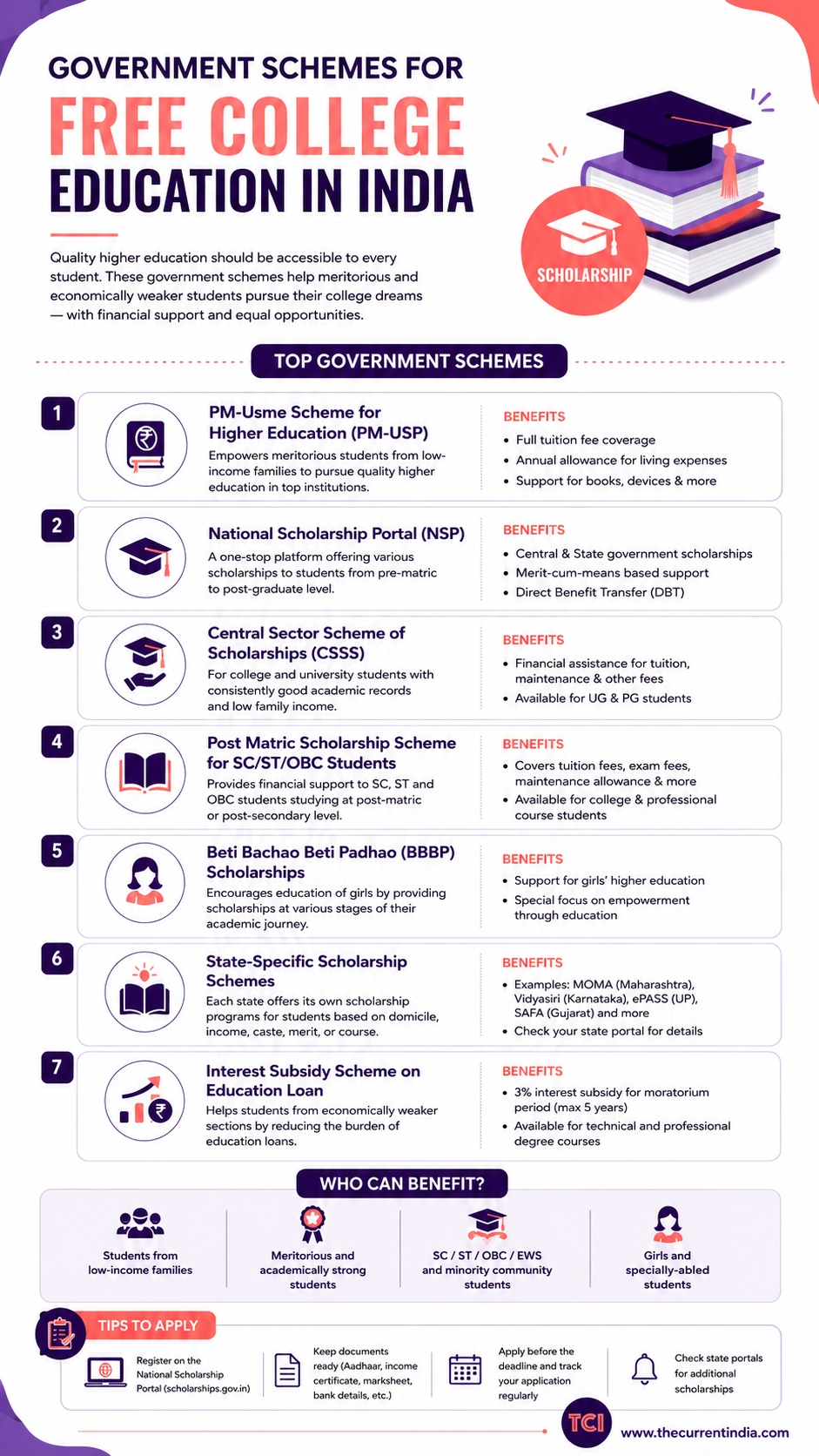
Frequently Asked Questions
Which is the best government scheme for free college education in India?
There’s no single “best” scheme — it depends on your category and course. For general-category students with strong marks, the Central Sector Scheme of Scholarship works well. For technical courses, AICTE’s Pragati, Saksham or Swanath schemes pay more (₹50,000/year). For SC/OBC/EBC/DNT students aiming at premier institutes, the Top Class Education Scheme gives the most complete cover.
Can general category students get any free education scheme?
Yes. The Central Sector Scheme of Scholarship and the PM-Vidyalaxmi loan scheme are open to general-category students, based purely on merit and income — not on caste or community.
Is PM-Vidyalaxmi a scholarship or a loan scheme?
It’s a loan scheme, not a scholarship. It gives you access to collateral-free, guarantor-free loans up to ₹10 lakh and reduces the interest you pay through a subvention — it doesn’t hand out non-repayable cash.
What is the income limit for most government scholarships?
It varies by scheme: ₹4.5 lakh a year for CSSS and CSIS, ₹8 lakh a year for the AICTE schemes and PM-Vidyalaxmi’s interest subvention, and as low as ₹1 lakh for some state-level professional-course waivers. Always confirm the current cap on the NSP listing before applying.
Can I apply for two government scholarships at the same time?
Generally, no. Most central scholarships explicitly disallow holding more than one at once, and applications get rejected if a duplicate claim is detected. Pick the scheme with the higher benefit for your profile.
Where do I apply for all these schemes?
Almost every central scheme is processed through the National Scholarship Portal at scholarships.gov.in. Loan schemes route through pmvidyalaxmi.co.in. State-level fee waivers are applied for through your state’s higher or technical education department website.
Do students in private colleges also qualify?
Yes, as long as the private college is approved by AICTE, UGC, or the relevant state regulatory body. Scholarship money doesn’t care whether the college is government-run or private — approval status is what matters.
The Bottom Line
Free or subsidized college education in India isn’t one scheme — it’s a layered system of scholarships, loan subsidies and state-level waivers that overlap by category, course and income. The fastest way to use it well is to register once on the National Scholarship Portal, match your profile against the tables above, and apply early; most deadlines fall between October and December.
The Current India will keep this guide updated as schemes are revised, renamed or replaced — check back before every admission cycle.
Source: NSP : National Scholarship Portal
Interesting Reads
- Are There Government Schemes Providing Free Digital Literacy Courses in India?
- PM SHRI Scheme -Transforming Indian Schools for a New Era of Education
- PM Kaushal Vikas Yojana (PMKVY)- Free Skill Training, Benefits, and How to Apply
- GDP Growth Rate For India – How Has India’s Economy Grown Since Independence?
- The PM Yashasvi Yojana: Everything You Need to Know
- Sukanya Samriddhi Yojana (SSY): Eligibility, Tax Benefits
- Future Skills Prime: How to Get Paid ₹12,000 by the Government to Learn AI
