PAN Card for Business: Documents Needed And Application Process
Most first-time founders don’t realize this: you cannot get a GSTIN, your GST registration number, without a PAN (Permanent Account Number). It’s a mandatory field on the GST registration form, and the two numbers stay linked for the life of your business (Razorpay, 2026).
If you’re setting up a company, LLP (Limited Liability Partnership), partnership, or even scaling a proprietorship, your PAN card is the first domino. Your bank account, GST registration, TDS (Tax Deducted at Source) filings, and vendor onboarding paperwork all depend on it.
What Is a Business PAN Card, and Why Does It Matter?
A business PAN card is a 10-digit code issued by the Income Tax Department to a company, LLP, firm, or other entity. It’s separate from the personal PAN of the owners or directors. It has no photograph and no father’s name field; instead, it carries the entity’s name and date of incorporation.
Key Takeaways
- A business PAN is mandatory for companies, LLPs, and firms; proprietors can usually use their personal PAN
- GST registration cannot be completed without a valid PAN. GSTIN is structurally built on top of it
- Business PAN issuance typically takes two to five weeks; some estimates put it closer to 15 days for standard applications
- New PAN application rules from April 2026 require more supporting documents than Aadhaar alone, and your name must match Aadhaar exactly
A business PAN card works as your company’s tax fingerprint. Without one, a company can’t file income tax returns, open a current account, deduct or file TDS, or register for GST. Banks, government departments, and large corporate buyers check it during vendor onboarding. Show up without it, and you hand them an easy reason to walk away.
A business PAN is not a stand-in for your Corporate Identification Number (CIN). CIN identifies the company’s registration; PAN identifies it for tax purposes.
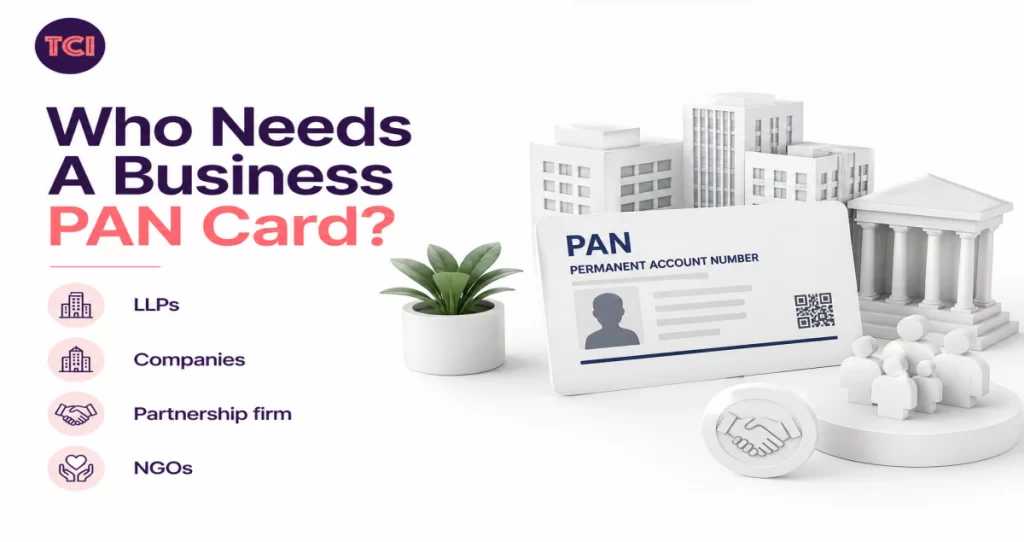
Who Needs a Business PAN Card?
Not every entity needs a separate PAN, and the rules differ by structure:
- Companies (Pvt Ltd, OPC, Section 8): Mandatory, and applied for automatically through the SPICe+ incorporation form .
- LLPs: Required for taxation and compliance filings.
- Partnership firms: Generally need their own PAN, separate from the partners’ personal PANs.
- Trusts, societies, NGOs: Required to manage donations, grants, and bank transactions transparently.
- Foreign entities operating in India: Branch offices, liaison offices, and subsidiaries all need PAN for tax compliance
- Sole proprietorships: The owner’s personal PAN usually works. But once GST registration, business banking, or high-value transactions enter the picture, a separate business identity often becomes necessary
A common and costly assumption among new founders is that a personal PAN can double as the company’s PAN. It can’t, and using one this way creates real tax and compliance headaches down the line
How to Apply for a PAN Card for Your Business
The application route depends on whether you’re incorporating fresh or adding PAN to an already-registered entity.
For new companies: PAN is bundled into the MCA’s SPICe+ form at the point of incorporation. There’s no separate step
For existing firms, LLPs, or trusts applying separately:
- Go to the Protean (formerly NSDL) or UTIITSL portal and select the new PAN application for the relevant entity type.
- Fill Form 49A with the entity’s name, date of incorporation or registration, mailing address, and registration number (CIN, LLPIN, or equivalent).
- Upload the Certificate of Incorporation or equivalent registration certificate. This typically covers both identity and address proof for the entity (Paisabazaar, 2026).
- Pay the processing fee, around ₹107 for an Indian mailing address, higher for addresses outside India.
- Submit and note the receipt number to track your application.
Business PAN issuance typically takes two to five weeks, depending on document accuracy and how you submit the application. Some estimates put it closer to 15 days for standard applications.
Read: Udyam Aadhar Card: Eligibility, Registration, Migration
Documents You’ll Need, by Entity Type
Keeping the right paperwork ready ahead of time avoids most delays:
- Companies: Certificate of Incorporation from the Registrar of Companies.
- LLPs: Certificate of Registration from the Registrar of Firms.
- Partnership firms: Copy of the Partnership Deed.
- Trusts: Trust Deed and registration certificate from the Charity Commissioner.
- Foreign entities: Certificate of Registration in the home country, plus any other document from a Central or State Government authority establishing identity.
PAN application rules changed on April 1, 2026. Until then, Aadhaar alone was often enough. Now applicants need to submit additional supporting documents, and the name on the PAN must match the Aadhaar record exactly. If you’re applying soon, double-check your Aadhaar spelling before you start the form.
Where PAN and GST Registration Connect
Your GSTIN isn’t an independent number. It’s structurally derived from your PAN, and without a valid PAN, GST registration cannot be completed (xlegal, 2026). Practically, that means:
- The GST registration application form has PAN as a mandatory, non-negotiable field.
- Your legal name on the GST application must match your PAN records exactly, or Aadhaar authentication fails and the whole process stalls.
- Aggregate turnover, meaning your total sales added up, decides whether registration is even required. It’s calculated across every business activity under the same PAN, nationwide, not state by state.
Lock down the PAN details before you start the GST application. Chasing a mismatch afterward adds weeks to the timeline.
Common Mistakes That Slow Everything Down
- Name mismatches: Your legal name must be identical across PAN, Aadhaar, and any GST application. Even a small spelling difference can fail Aadhaar authentication
- Using a personal PAN for a registered company: This works for sole proprietors but creates compliance problems for companies, LLPs, and firms that need their own PAN.
- Bank account name mismatch: For non-proprietorship entities, the current account name must match the registered business name exactly.
The Bottom Line
A business PAN card is the identity your GST registration, your bank account, and your tax filings all sit on top of. Get the entity name, documents, and Aadhaar details aligned before you apply, and the process moves faster than the horror stories suggest.
This article is for general informational purposes and isn’t a substitute for advice from a chartered accountant or tax professional familiar with your specific business structure.
Interesting Reads
- Top 8 Government Scheme for Startups in India – Complete Guide
- Government Schemes for Female Entrepreneurs in India – Guide to Loans, Subsidies and Start-Up Support
Sources
- Razorpay: Company Permanent Account Number (PAN) Card
- Angel One: What is Business PAN Card & How to Apply?
- xlegal: Company PAN Card Registration India 2026
- busy.in: GST Registration Turnover Limit 2026: Threshold & Consequences
- gimbooks: GST Registration Procedure Explained for Indian Businesses 2026
- NewsBytes: PAN application rules changing from April 1: What to know
- ClearTax: PAN Card for Company – Process and Document Required
- ClearTax: PAN Card – What is PAN Card, Overview, Importance, Types and Eligibility
- ClearTax: GST Registration Online: Documents Required, Limit, Fees, Process, Penalty
- BizSetups: PAN Card for Company Registration India 2026
- Axis Bank: Business Pan Card: Meaning, Benefits, Documents & Application Process
- Paisabazaar: PAN Card for Company – Document Required and Process for Business Pan Card
- MyOnlineCA: Documents Required for Business Pan Card in India
- Right to Information Wiki: How to apply for GST registration, turnover thresholds and steps (2026)
