Health Insurance for NRIs Visiting India: A Comparison of the Best Plans
You fly in from Dubai or Chicago for a two-week visit, and a sudden fever turns into a hospital admission. Your foreign health plan won’t touch the bill. That exact gap is what health insurance for NRIs exists to close.
The Ministry of External Affairs counts roughly 3.54 crore overseas Indians, including 1.59 crore NRIs (MEA data via Ditto’s NRI Health Insurance Guide, 2026). Most still treat Indian health cover as an afterthought, right up until a parent, or they themselves, need a hospital bed. This guide compares the health insurances for NRIs worth shortlisting, flags what most comparison articles skip, and walks through how to buy and claim.
Key Takeaways
- NRIs, OCIs, and PIOs buy the same standard Indian health policies residents do; there’s no separate “NRI product” category (Ditto, 2026).
- HDFC ERGO, Niva Bupa, and Care Health lead 2026’s NRI-focused lineup, each on a different strength (The Avenue Mail, 2026).
- A high claim settlement ratio by policy count can hide a much lower rate by claim value; check both (Algates Insurance, 2026).
- Buy 24-36 months before an expected visit or relocation so waiting periods lapse before you need the cover (Ditto, 2026).
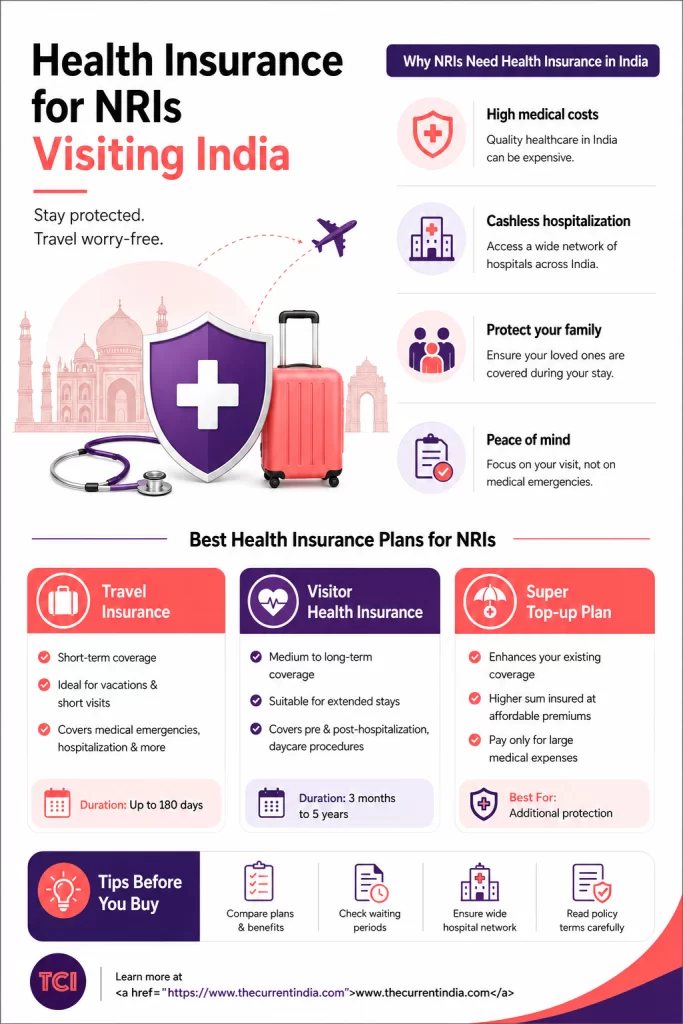
What Is Health Insurance for NRIs, and Do You Need It?
No separate insurance category exists for non-residents. NRIs, OCIs, and PIOs buy the same domestic health plans resident Indians buy, though insurers ask about residency status during underwriting (Ditto’s NRI Health Insurance Guide, 2026). The product stays identical; your usage pattern, short visits instead of daily life in India, is what differs.
Most comparison articles skip this: your Dubai or US employer plan almost certainly stops working the moment you land in Mumbai. Group and international policies carry geographic limits, and Indian hospitals rarely have direct billing arrangements with foreign insurers (HDFC Life, 2025). Even a “comprehensive” overseas plan can leave you paying cash upfront and chasing reimbursement for months afterward.
An India-based policy fixes that instantly. You get cashless admission at network hospitals, a claims process built around the Indian system, and continuous cover whether you’re here for two weeks or two years. It matters most for two groups: frequent visitors juggling short trips, and NRIs with aging parents in India or a planned return within a few years.
Why Do NRIs Need a Separate Indian Policy?
Indian medical inflation is running at 10-12% a year in 2026, and a single unplanned hospitalisation can wipe out months of savings without cover in place (The Avenue Mail, 2026). That one number explains why waiting until mid-visit to shop for insurance is a costly habit.
Three reasons stand out. First, cost: Indian treatment costs less than care in the US, UK, or Gulf, and premiums on Indian policies run lower than international cover too. Many NRIs plan elective procedures around a visit home instead of paying Western prices.
Second, claims friction: foreign medical records arrive in different formats and languages, and insurers sometimes need to contact an overseas doctor for verification, which slows settlement (Ditto, 2026). Filing with an India-based insurer sidesteps that problem. Third, the waiting-period clock: pre-existing condition waiting periods run 24-48 months at most insurers, so buying early starts that clock years before you need to claim (Niva Bupa’s Top-Rated Guide, 2026).
The “Two Separate Plans” Rule
Don’t ask one policy to do two jobs. Keep your home-country plan for coverage where you live, and a separate India-specific plan for visits, parents, or an eventual return. Don’t assume one plan quietly covers both. Ditto’s advisory team makes this explicit: rely on a single blended policy and you’ll likely discover the geographic exclusions only after a claim gets rejected (Ditto, 2026).
Read: Mutual Funds For NRIs In India: Where to Invest in 2026
Best Health Insurance Plans for NRIs: Side-by-Side Comparison
Three insurers have consistently led 2026’s NRI-focused lineup: Niva Bupa, Care Health, and HDFC ERGO, each balancing high sum insured against strong service (The Avenue Mail, 2026). Ditto’s own 2026 guide names HDFC ERGO’s Optima Secure as its top pick, citing a 96.71% claim settlement ratio and a network above 13,000 hospitals.
| Insurer & Plan | Sum Insured Range | Network Hospitals | Standout Feature | Notable Caveat |
|---|---|---|---|---|
| HDFC ERGO Optima Secure | ₹5 lakh – ₹2 crore | 13,000–15,000+ | 100% automatic restore benefit; no room rent cap; global rider available | Global cover is an add-on, not default |
| Niva Bupa ReAssure 3.0 | Up to unlimited | 10,400+ | Unlimited sum insured; “ReAssure Forever” refill after first claim | Unlimited variants carry higher premiums |
| Care Health (Care Supreme) | ₹5 lakh – ₹6 crore | Wide pan-India network | Strong CSR track record; 100% restoration | Room rent rules vary by variant; read the fine print |
| Star Health Assure | ₹5 lakh – ₹2 crore | Large network, dedicated NRI desk | Decades of NRI-specific claims experience | CSR by policy count sits below the other four insurers here (see below) |
| Tata AIG Health | ₹5 lakh – ₹1 crore+ | Extensive network | Balanced across CSR, ICR, and grievance metrics | Fewer NRI-specific marketing features than Niva Bupa or Care |
CSR by policy count and CSR by claim amount can tell very different stories for the same insurer. IRDAI’s FY 2024-25 data shows this gap most starkly at Oriental Insurance, a strong 93.3% by policy count but only 39.3% by claim amount, meaning it settles a high volume of claims but pays out a much smaller share of the total value claimed (Algates Insurance, 2026). Among the five insurers in our table, Star Health has the lowest count-based CSR at roughly 86%, still respectable, but the weakest of the five, and worth weighing alongside its higher industry-wide complaint volume.
What Should NRIs Check Before Signing Up?
Every plan in that table looks strong on paper. The differences show up in the exclusions. Room rent capping is the first thing to check: some policies cap the daily room rate at 1-2% of the sum insured, and exceeding it triggers a proportionate cut across the entire bill, not just the room charge (GetBelong, 2025).
Cross-checking the five plans in our table: four of them (HDFC ERGO Optima Secure, Niva Bupa ReAssure 3.0, Care Supreme, and Tata AIG’s flagship plan) now advertise no room rent capping at all. That’s a real shift from a few years ago, when sub-limits were standard even on premium policies.
Second, pre-existing disease waiting periods. These typically run 24-48 months, though Niva Bupa’s ReAssure 3.0 offers an optional waiver on up to 145 listed conditions for policyholders willing to pay a higher premium (Niva Bupa, 2026). If you’re an NRI in your 50s or 60s with an existing condition, that single feature can outweigh a cheaper premium elsewhere.
Third, check whether the plan covers treatment outside India. Base plans don’t, by default. HDFC ERGO’s Optima Secure Global variant and similar riders from Niva Bupa now let the same policy extend to critical-illness treatment in the US, UK, or UAE, layered on top of the Indian base plan (The Avenue Mail, 2026).
The NRI Discount Trap
Some insurers dangle an “NRI discount” for policies bought entirely in foreign currency or through specific NRI-only channels. Skip it unless the insurer states the terms in plain language upfront. The discount can get clawed back at claim time through added documentation demands or disputed eligibility, and the saving rarely justifies that risk (Ditto, 2026). A slightly higher premium on a standard resident-equivalent plan is often the safer bet.
How Do NRIs Actually Pay Premiums and File Claims?
Premiums must move through a tracked banking channel, an NRE or NRO account, to stay FEMA-compliant, and claim payouts can be routed back to those same accounts in foreign currency, up to the total premium paid (Policybazaar, 2025). FEMA compliance requires this: it’s the legal basis the entire NRI policy structure rests on.
The buying process mirrors what a resident goes through, with one extra step: KYC verification using your passport, OCI card, or overseas address proof (Kotak, 2026). Most insurers now also offer tele-medical underwriting, so required health checks happen over video call instead of a physical exam during a flying visit (Niva Bupa’s Top-Rated Guide, 2026).
At claim time, cashless treatment at a network hospital is the smoother path. The hospital bills the insurer directly, and you walk out without an upfront payment. Reimbursement claims, used for out-of-network hospitals, require settling the bill first and submitting documents within a set window, typically 30 days from discharge (Kotak, 2026).
Are There Tax Benefits for NRIs Buying Health Cover in India?
Section 80D lets NRIs claim a deduction on premiums paid for their own policy and for parents living in India, adjustable against Indian income like rental earnings or dividends (The Avenue Mail, 2026). Under the old tax regime, NRIs can typically claim up to ₹25,000 for their own premium, plus up to ₹50,000 more if the premium covers senior-citizen parents.
Some sources cite a combined ceiling of ₹1,00,000 when both the policyholder and parents are senior citizens, but industry guidance is inconsistent on whether NRIs qualify for the higher senior-citizen slab on their own premium, so confirm the exact figure with a tax advisor before assuming the maximum applies to you.
That detail changes the math on “buy now or wait.” A policy bought early clears waiting periods and starts generating a tax deduction from year one, renewed each year after. Skip a year, and you lose that deduction along with the progress on your waiting-period clock.
Choosing the Right Plan for Your Situation
No single “best” plan exists here. The right one depends on why you’re buying it. Visiting occasionally? Prioritise a strong network and fast cashless approval, which points toward Niva Bupa or HDFC ERGO. Insuring aging parents? Look hard at restoration benefits and no room-rent-cap features across Care Health and HDFC ERGO’s Optima Secure. Planning to relocate in a few years? Buy now, regardless of insurer, since the waiting-period clock only starts once the policy is active.
No matter which plan you land on, don’t rely on your foreign employer’s health cover to protect you in India. It almost certainly won’t. Pair it with an Indian policy, keep both insurers informed of any diagnoses, and revisit this comparison every renewal cycle, since claim settlement ratios and features shift year to year.
Frequently Asked Questions
Can NRIs buy health insurance in India without visiting in person?
Yes. Most insurers, including HDFC ERGO and Niva Bupa, allow fully digital applications with tele-medical exams for NRIs, so a physical visit usually isn’t required (Niva Bupa, 2026). You’ll still need KYC documents like a passport or OCI card, plus premium payment through an NRE or NRO account under FEMA rules.
What’s the waiting period for pre-existing diseases on NRI health plans?
Most insurers apply a 24-48 month waiting period for pre-existing conditions before claims are payable (Niva Bupa’s Top-Rated Guide, 2026). Some plans, like Niva Bupa ReAssure 3.0, offer an optional paid waiver on up to 145 named conditions.
Do these plans cover treatment outside India?
Generally, no. Base plans cover hospitalisation within India only. Premium variants increasingly bundle a global rider, letting you access US, UK, or UAE treatment for critical illnesses on top of the domestic base cover (The Avenue Mail, 2026).
Is claim settlement ratio alone enough to judge an insurer?
Not on its own. A high CSR by policy count can hide a much lower settlement rate by claim value, which matters more for the larger claims NRIs tend to file (Algates Insurance, 2026). Check both figures, plus the customer grievance ratio, before deciding.
Can NRIs insure their parents living in India separately?
Yes, and it’s one of the most common reasons NRIs buy Indian health cover. Family floater and senior-citizen-specific plans, like Niva Bupa’s Senior First, are built for exactly this, with sum insured options up to ₹25 lakh or higher (Policybazaar’s NRI guide, 2026).
Conclusion
Health insurance for NRIs is the same Indian policy everyone else buys, used strategically. Buy early to clear waiting periods and start banking Section 80D deductions. Compare claim settlement ratio by both count and value, not just the headline number. Match the plan to why you need it: frequent visits, aging parents, or a future move back.
Shortlist two or three plans from the comparison table above, get live quotes, and confirm the room rent and waiting-period terms in writing before you buy. That’s the step most NRIs skip, and the one that decides whether a claim gets paid smoothly or turns into a fight.
Interesting Reads
- Minor Passport Renewal for NRIs: Complete Guide for Parents Living Abroad
- NRI PAN Card vs OCI Card: Which One Do You Actually Need?
- NRI Passport Renewal – Complete Guide for Indians Living Abroad
- Power of Attorney for NRIs: Types, How To Get One, Fee
- DigiLocker for NRIs: How to Store and Access Indian Documents from Abroad
- e-OCI card: What Is It, Steps To Download
Sources:
- Ditto, NRI Health Insurance in India: 2026 Complete Guide, retrieved 2026-07-07, https://joinditto.in/articles/health-insurance/health-insurance-for-non-resident-indians/
- HDFC Life, Buy Best Health Insurance for NRI in India, retrieved 2026-07-07, https://www.hdfclife.com/health-insurance-plans/health-insurance-for-nri
- Policybazaar, Health Insurance for NRIs: Compare & Buy, retrieved 2026-07-07, https://www.policybazaar.com/health-insurance/nri/
- Mypursu, Best Health Insurance Options for NRIs Living Abroad, retrieved 2026-07-07, https://mypursu.com/blog/best-health-insurance-options-for-nris
- The Avenue Mail, Which Private Health Insurance in India Is Best for NRI Families Living Abroad, retrieved 2026-07-07, https://avenuemail.in/best-private-health-insurance-india-nri-families-2026/
- Niva Bupa, Top Rated Health Insurance in India for NRIs 2026, retrieved 2026-07-07, https://www.nivabupa.com/health-insurance-articles/top-rated-health-insurance-india-nri-2026.html
- Kotak, Can NRIs Apply for Health Insurance in India?, retrieved 2026-07-07, https://www.kotak.bank.in/en/stories-in-focus/nri/health-insurance-for-nris-in-india.html
- Algates Insurance, Claim Settlement Ratio 2025: Which Insurer Pays Best?, retrieved 2026-07-07, https://algatesinsurance.in/insurance-infographic/which-health-insurer-is-best-at-settling-claims/
- GetBelong, Best Health Insurance Options for Retired NRIs in India, retrieved 2026-07-07, https://getbelong.com/blog/health-insurance-for-retired-nris/
- HDFC ERGO, my:Optima Secure Health Insurance, retrieved 2026-07-07, https://www.hdfcergo.com/health-insurance/optima-secure/
- Niva Bupa, ReAssure 3.0 Health Insurance Policy, retrieved 2026-07-07, https://www.nivabupa.com/family-health-insurance-plans/reassurev3-insurance.html
