Power of Attorney for NRIs: The Complete Guide
TL;DR
Power of Attorney for NRIs is a legal tool that lets an NRI give someone in India the authority to manage their affairs. You need to sign it abroad, get it notarized or consulate-attested, send it to India, pay stamp duty, and register it. A Specific POA is safer for one-time property deals. A General POA gives broader powers. Cost: roughly Rs. 500 to Rs. 5,000 depending on state and purpose
Power of attorney for NRIs is one of the most important legal tools available to Indians living abroad. If you own property in India, have a bank account, need to file taxes, or have any financial affairs back home, a POA lets you hand over the authority to a trusted person to act on your behalf.
This guide explains everything clearly and simply, so even if you have no legal background, you will know exactly what to do.
What Is a Power of Attorney?
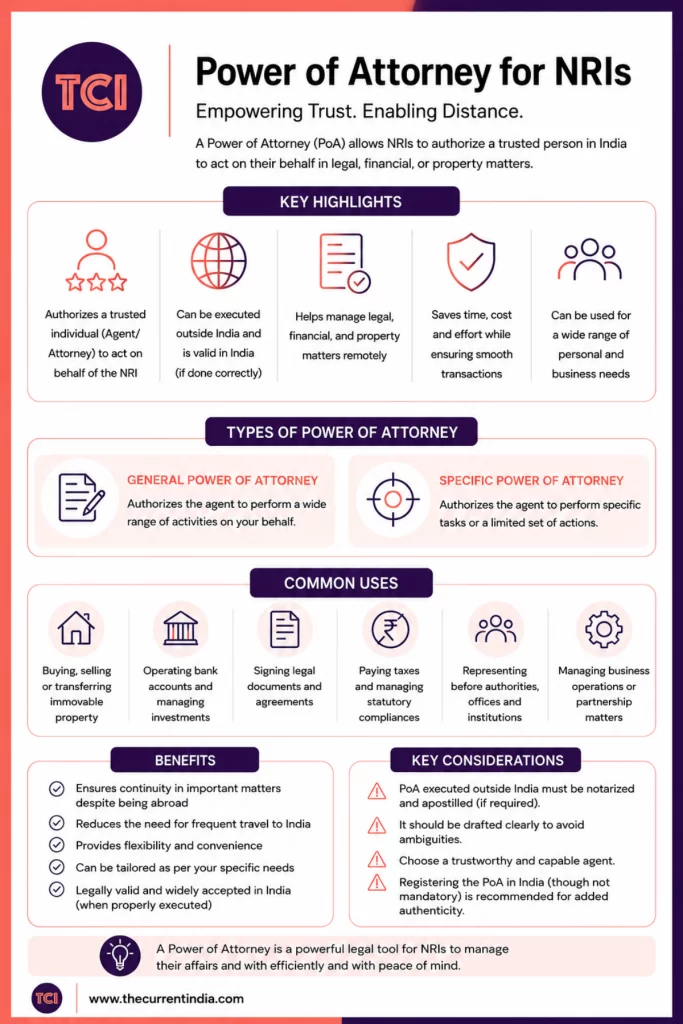
A Power of Attorney is a written legal document. Through it, one person (called the principal or donor) gives another person (called the agent or attorney) the authority to act on their behalf.
For NRIs, this is critical. You cannot always fly to India to sell a property, close a bank account, or appear before a government office. A POA solves that problem. Your appointed agent can do all of this in your place, legally.
The person you appoint does not have to be a lawyer. It can be a parent, sibling, spouse, friend, or any trusted individual.
Types of Power of Attorney for NRIs
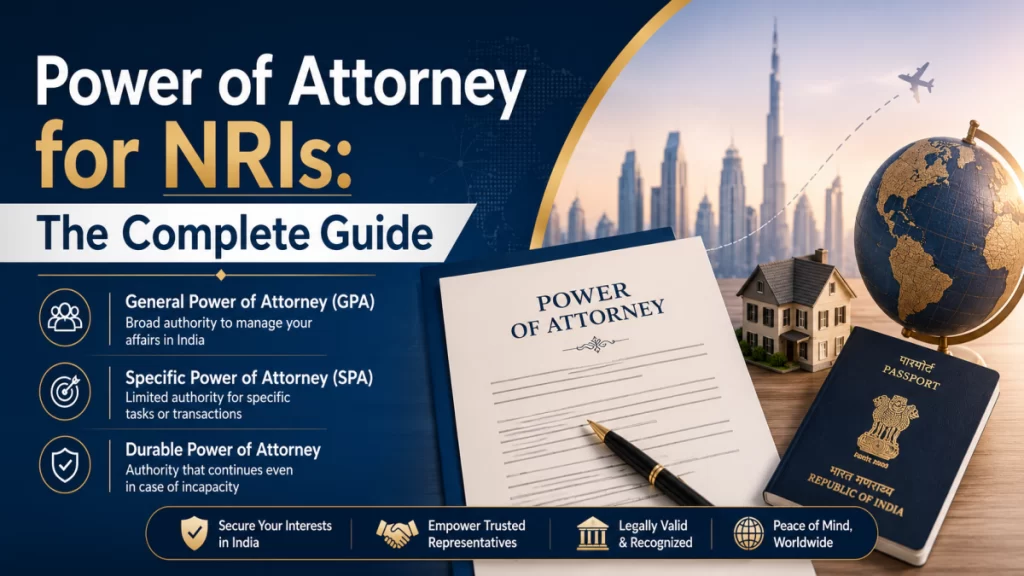
General Power of Attorney (GPA)
A General POA gives your agent broad authority. They can handle banking, property, taxes, court matters, and more. It is best used when you need someone to manage a wide range of tasks over a period of time.
Be careful here. A General POA gives a lot of power. Only grant it to someone you completely trust.
Specific Power of Attorney (SPA)
A Specific POA covers one particular task or transaction. For example: selling a specific flat in Bengaluru. Once that task is done, the POA becomes void. This is the safer option for property deals.
Durable Power of Attorney
A Durable POA remains valid even if the principal becomes mentally incapacitated. This is less common in India but recognized in some contexts, especially for elderly NRIs planning for the future.
Revocable vs. Irrevocable POA
Most POAs are revocable. The principal can cancel them at any time by executing a revocation deed. An irrevocable POA can only be revoked under specific conditions agreed upon at the time of creation.
Read more on – Power Of Attorney In India – The Types And How To Get One?
Step-by-Step Process to Create a Power of Attorney for NRIs
Here is how the process works, from drafting to registration in India.
Step 1: Draft the POA
Start by drafting the POA document. You can use a lawyer in India or abroad. The document should clearly state the name of the principal and the agent, the specific powers being granted, the duration of the POA, and the property or matter it relates to.
Drafting in India is easier because Indian lawyers know what local registration offices expect.
Step 2: Get It Notarized or Consulate-Attested Abroad
Once drafted, you need to sign the POA in the country where you currently live. Two options exist:
- Notarization: A local notary public in your country witnesses and certifies your signature.
- Consulate Attestation: You visit the Indian Embassy or High Commission and they attest the document. This is more widely accepted in India.
Consulate attestation is strongly recommended for property-related POAs.
Step 3: Send the POA to India
After signing and attestation, send the original document to your agent in India. Use a reliable courier service. Keep a notarized copy with you.
Step 4: Pay Stamp Duty in India
Your agent must pay stamp duty on the POA in India. The stamp duty amount varies by state. In most states, the duty is nominal for non-property POAs. For property transactions, the duty can be higher.
Step 5: Register the POA (Mandatory for Property)
For any property transaction, the POA must be registered at the local Sub-Registrar’s office in India. The agent presents the POA document along with the original drafts, pays the registration fees, and completes the process.
Unregistered POAs are not valid for property registration. Do not skip this step.
How NRIs in Different Countries Can Create a Power of Attorney
Power of Attorney for NRIs in the UK
NRIs in the UK can get their POA notarized by a UK notary public. Alternatively, visit the Indian High Commission in London (or consulates in Birmingham, Edinburgh, etc.) for attestation. UK-notarized POAs must be apostilled under the Hague Apostille Convention, since the UK is a signatory. India also accepts apostilled documents under this convention.
The process:
- Draft POA in India or with a UK-based Indian legal consultant.
- Sign before a UK notary public.
- Get the Apostille stamp from the UK Foreign, Commonwealth and Development Office (FCDO).
- Send to India. Your agent pays stamp duty and registers it.
Power of Attorney for NRIs in Australia
NRIs in Australia follow a similar path. Australia is also a signatory to the Hague Apostille Convention.
- Sign the POA before an Australian notary public.
- Get an Apostille from the Australian Department of Foreign Affairs and Trade (DFAT).
- Alternatively, visit the Indian High Commission in Canberra or consulates in Melbourne, Sydney, or Perth.
- Send the attested POA to India for stamp duty and registration.
Digital POA options are limited. As of 2024, India’s registration process still requires original physical documents for property transactions. Some states allow e-stamping, but you still need the signed original to be physically present for registration.
Power of Attorney for NRIs in the US
The US is not a signatory to the Hague Apostille Convention as far as India is concerned for this purpose. Indian Consulates in the US (in cities like New York, Houston, Chicago, San Francisco, and Atlanta) provide attestation services. NRIs in the US should get their POA attested at the nearest Indian Consulate for the highest level of acceptance in India.
Documents Required for Power of Attorney for NRIs
Here is what you typically need. Requirements may vary slightly by state.
- Draft POA document (2 copies at minimum)
- Passport copy of the NRI (principal)
- Passport copy of the agent in India
- Proof of address of the NRI abroad
- Photograph of the NRI (passport size)
- Property documents (if the POA is for property transactions)
- Visa or residency proof in the foreign country
- Consulate fee payment receipt (if attested at Indian Consulate)
How Much Does a Power of Attorney for NRIs Cost?
Costs vary depending on where you are and what the POA covers. Here is a realistic breakdown.
| Component | Estimated Cost | Notes |
| Drafting fees (lawyer in India) | Rs. 2,000 to Rs. 10,000 | Depends on complexity |
| Notary fees abroad | $50 to $200 (approx.) | Varies by country and notary |
| Indian Consulate attestation fee | $20 to $50 | Check your consulate website |
| Apostille fees (UK/Australia) | GBP 30 to GBP 75 / AUD 50 to AUD 120 | Charged by foreign affairs dept. |
| Stamp duty in India | Rs. 100 to Rs. 5,000+ | Varies by state and POA type |
| Registration fee in India | Rs. 500 to Rs. 2,000 | Mandatory for property POA |
| Courier (abroad to India) | Rs. 2,000 to Rs. 4,000 (approx.) | Use a tracked courier |
For a Specific POA covering a single property transaction, total costs typically range from Rs. 8,000 to Rs. 20,000 when all components are added up.
Stamp Duty Requirements for NRI Power of Attorney in India
Stamp duty on a POA is governed by state-specific stamp acts. The rates differ significantly. Here is a general guide.
| State | Stamp Duty on General POA | Stamp Duty on Specific POA (Property) |
| Maharashtra | Rs. 100 to Rs. 500 | Rs. 500 to Rs. 5,000 (value-based) |
| Delhi | Rs. 100 | Rs. 500 to Rs. 2,000 |
| Karnataka | Rs. 500 | Rs. 500 to Rs. 5,000 |
| Tamil Nadu | Rs. 100 | Rs. 100 to Rs. 500 |
| Uttar Pradesh | Rs. 100 to Rs. 500 | Rs. 200 to Rs. 2,000 |
Always verify the current rates with a local sub-registrar or a lawyer, as stamp duty rates are revised periodically.
What Are the Best Indian Mutual Fund Schemes for NRIs?
Many NRIs want to invest in Indian mutual funds while managing assets back home. A POA can authorize an agent to handle your mutual fund transactions as well. Here is an overview of popular and well-regarded fund categories for NRIs, based on publicly available performance data.
Note: NRIs from the US and Canada face restrictions due to FATCA/FBAR compliance. NRIs from other countries can generally invest freely.
| Fund Category | Risk Level | Suitable For | FATCA Restriction (US/Canada NRIs) |
| Large-cap equity funds | Moderate | Stable long-term growth | Yes (check AMC) |
| ELSS (Tax Saving Funds) | Moderate to High | Tax savings under Section 80C | Yes (check AMC) |
| Flexi-cap funds | Moderate to High | Diversified equity exposure | Yes (check AMC) |
| Debt/Liquid funds | Low to Moderate | Short-term parking of funds | Generally Yes |
| Index funds (Nifty/Sensex) | Moderate | Passive, low-cost exposure | Yes (check AMC) |
| Balanced advantage funds | Moderate | Dynamic equity-debt allocation | Yes (check AMC) |
NRIs must invest through NRE or NRO accounts. NRE account investments are fully repatriable. NRO account investments have repatriation limits of USD 1 million per financial year.
Consult a SEBI-registered investment advisor before making any investment decisions. Thecurrentindia.com recommends always taking personalized financial advice for cross-border investments.
Validity and Revocation of NRI Power of Attorney
How Long Is an NRI POA Valid?
A POA is valid until the principal revokes it, it expires (if a time limit is stated), the principal dies, or the task is completed (for Specific POA). There is no automatic expiry period unless you specify one.
How to Revoke a Power of Attorney
- Execute a formal revocation deed in India.
- Register the revocation deed at the same Sub-Registrar office where the original POA was registered.
- Notify all relevant parties (banks, government offices, etc.) in writing.
- Publish a revocation notice in a local newspaper if necessary.
Risks to Watch Out For
POA misuse is a real risk. Here is what you must do to protect yourself.
- Never give General POA to someone you do not fully trust.
- Limit the scope of the POA to only what is necessary.
- Set an expiry date if possible.
- Keep certified copies of the POA yourself.
- Regularly check on the transactions your agent is executing.
- Review your property records in India periodically through official land record portals.
Legal Framework Governing Power of Attorney for NRIs
Several Indian laws govern POA creation and use:
- The Powers of Attorney Act, 1882: The core legislation governing POAs in India.
- The Registration Act, 1908: Requires registration of POAs used for immovable property.
- The Indian Stamp Act, 1899 (and state amendments): Governs stamp duty.
- The Foreign Exchange Management Act (FEMA): Governs NRI financial transactions.
- The Income Tax Act, 1961: Relevant when the agent handles tax filings.
Frequently Asked Questions On Power Of Attorney For NRIs
How can NRIs in the UK create a valid power of attorney for property in India?
NRIs in the UK must sign the POA before a UK notary public and either get an Apostille from the UK Foreign, Commonwealth and Development Office (FCDO) or get it attested at the Indian High Commission in London. The attested document is then sent to India, where the agent pays stamp duty and registers it at the Sub-Registrar’s office. Consulate attestation is more widely accepted than Apostille alone for property matters.
What are the legal requirements for power of attorney documents for NRIs residing in the UK?
The POA must be signed by the NRI principal in the UK, witnessed by a UK notary public or attested at the Indian Consulate, and stamped with either an Apostille or consulate seal. In India, it must be adjudicated for stamp duty and registered at the relevant Sub-Registrar office if it relates to immovable property. The agent must carry the original document for registration.
How can I create a power of attorney from Australia?
Australian NRIs can sign the POA before an Australian notary public and get an Apostille from the Australian Department of Foreign Affairs and Trade (DFAT). They can also visit the Indian High Commission in Canberra or Indian consulates in Sydney, Melbourne, or Perth for direct attestation. After attestation, send the original document to India for stamp duty payment and registration.
What documents are required for power of attorney for NRIs living abroad?
You need the drafted POA document, your passport copy, your agent’s passport copy, your proof of address abroad, passport-size photographs, property documents (if property-related), and visa or residency proof. For consulate attestation, you also need the consulate’s fee payment receipt. Requirements may vary slightly by country and state in India.
Can I get a digital power of attorney in Australia?
No fully digital POA process currently exists for NRIs that is accepted by India’s property registration system. While e-stamping is available in some Indian states, the original signed and attested document still needs to be physically present at the Sub-Registrar’s office for property registration. Electronic attestation options are limited and not universally accepted as of 2024.
How much does it cost to get a power of attorney for an NRI?
Total costs depend on your location and the POA’s purpose. Drafting costs between Rs. 2,000 and Rs. 10,000 in India. Notary or consulate fees abroad range from $20 to $200. Stamp duty in India ranges from Rs. 100 to Rs. 5,000+ depending on the state and transaction type. Registration fees are Rs. 500 to Rs. 2,000. Courier costs add another Rs. 2,000 to Rs. 4,000. Budget roughly Rs. 8,000 to Rs. 25,000 for a complete property-related POA.
What are the stamp duty requirements for an NRI power of attorney in India?
Stamp duty is governed by state-specific acts and varies across India. In Maharashtra, it ranges from Rs. 100 for a basic General POA to Rs. 5,000 for property-related transactions. Delhi charges Rs. 100 for a General POA. Karnataka charges Rs. 500 as a base rate. The duty is paid in India by the agent when the POA document arrives. E-stamping is available in many states and is the preferred method now.
Final Thoughts
Power of attorney for NRIs is not just a legal formality. It is a practical tool that lets you protect and manage your assets in India without being physically present. Done correctly, it gives you peace of mind. Done carelessly, it opens the door to risk.
Take time to draft the POA carefully. Work with a registered lawyer in India. Get it attested properly. Register it. And always choose your agent wisely.
Thecurrentindia.com covers legal, financial, and policy topics that matter to Indians at home and abroad. For more guides like this, visit thecurrentindia.com.
| Disclaimer This article is for informational purposes only. It does not constitute legal or financial advice. Laws and procedures change. Always consult a qualified lawyer or financial advisor before executing a Power of Attorney or making investment decisions. |
Interesting Reads
- Mutual Funds For NRIs In India
- OCI Card Application: Complete Guide for Indians in USA & UK
- DTAA India for NRIs – How India’s Double Taxation Avoidance Agreement Works
- Minor Passport Renewal for NRIs: Complete Guide for Parents Living Abroad
- NRI Passport Renewal – Complete Guide for Indians Living Abroad
- NRI PAN Card vs OCI Card: Which One Do You Actually Need?
- Health Insurance for NRIs Visiting India: A Comparison of the Best Plans
- Legal Heir Certificate In India: Apply, Documents Needed
