DTAA India for NRIs – How India’s Double Taxation Avoidance Agreement Works

QUICK SUMMARY | What Is DTAA India for NRIs?
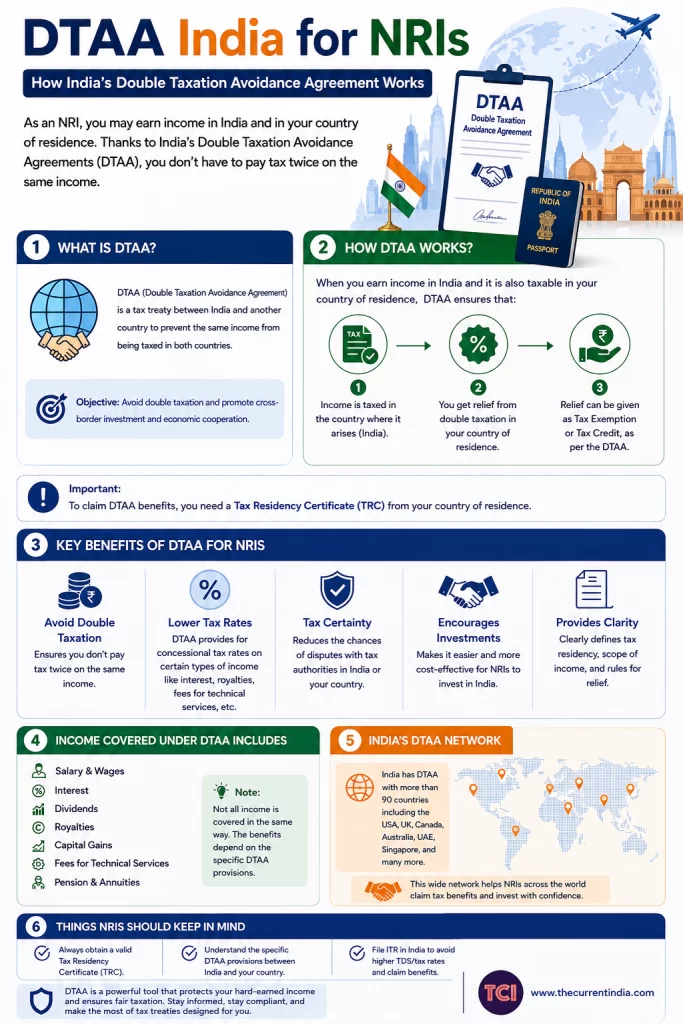
DTAA India (Double Taxation Avoidance Agreement) is a tax treaty India signs with other countries so NRIs do not pay tax twice on the same income. Here is what you need to know:
- India has active DTAA treaties with 90+ countries, including the USA, UK, Canada, UAE, Australia, and Germany.
- DTAA lets you either exempt income from tax in one country or claim a credit for tax already paid abroad.
- NRIs must submit a Tax Residency Certificate (TRC) and Form 10F to claim DTAA benefits.
- DTAA covers salary, interest, dividends, royalties, capital gains, and business profits.
- Capital gains treatment varies by treaty, so always check your specific country’s DTAA with India.
Source: The Current India (thecurrentindia.com) | Verified against Income Tax Act, 1961 and CBDT circulars.
Table of Contents
What Is DTAA India and How Does It Work?
If you are a Non-Resident Indian (NRI) earning income in India, you might worry about paying tax in two countries on the same money. The DTAA (Double Taxation Avoidance Agreement) solves exactly that problem.
India signs DTAA treaties with other countries so that NRIs do not pay tax twice on the same income. Think of it as a rulebook between two governments that says: ‘We agree on who gets to tax this income, and by how much.’
How DTAA India works in three simple steps:
- You earn income in India (salary, interest, rent, dividends, capital gains).
- That income may also be taxable in your country of residence.
- DTAA steps in and either exempts the income in one country or allows you to claim a tax credit so you are not taxed twice.
India’s Income Tax Act, 1961 (Section 90 and Section 90A) governs how DTAA operates. When a DTAA exists between India and your country of residence, you can choose whichever treatment (domestic tax law or DTAA) is more favorable to you. The DTAA always wins when it offers a lower tax rate.
Read: Mutual Funds For NRIs In India: Where to Invest in 2026
Which Countries Have a DTAA Agreement with India?
India has signed DTAA treaties with more than 90 countries. The list covers most major destinations where NRIs live and work. Here are some of the most important ones:
| Country | Dividend TDS Rate | Interest TDS Rate | Capital Gains Rule |
| USA | 15% (dividends) | 15% (interest) | Residence country taxed |
| UAE | 0% | 0% | No income tax in UAE |
| UK | 15% | 15% | Residence country taxed |
| Canada | 25% | 15% | Residence country taxed |
| Australia | 15% | 15% | Residence country taxed |
| Germany | 10% | 10% | Residence country taxed |
| Singapore | 10% | 10% | Residence country taxed |
| Netherlands | 10% | 10% | Residence country taxed |
| Japan | 10% | 10% | Residence country taxed |
| Mauritius | 0% (historical) | Varies | Special capital gains rules |
You can find the full, official list on the Income Tax India website at incometaxindia.gov.in under the ‘International Taxation’ section. The CBDT (Central Board of Direct Taxes) maintains and updates the treaty list.
Pro tip: Not all treaties are equal. The specific rates and rules depend on the exact wording of each bilateral treaty. Always check your country’s specific DTAA with India before claiming any benefit.
How Does DTAA Benefit Non-Resident Indians?
DTAA gives NRIs three core advantages:
1. Reduced TDS (Tax Deducted at Source) Rates
Without DTAA, Indian banks deduct TDS at 30% on NRO account interest. With DTAA, that rate can drop to 10% to 15%, depending on your country of residence. This directly increases your take-home income from Indian investments.
2. Tax Credits in Your Country of Residence
When India taxes your Indian income and your country of residence wants to tax it too, DTAA allows you to claim a credit for the tax already paid in India. You do not pay the full tax twice. You pay the difference (if any).
3. Exemption from Tax in One Country
Some DTAAs fully exempt certain income from tax in one of the two countries. For example, NRIs in the UAE (which has no personal income tax) often face zero combined tax on certain India-sourced income because of how the India-UAE DTAA is structured.
Summary of DTAA Relief Methods
| Relief Method | How It Works | Example |
| Exemption Method | Income taxed in only one country | India-UAE DTAA on salary |
| Tax Credit Method | Tax paid abroad reduces Indian tax liability | India-USA DTAA on salary |
| Reduced TDS Rate | Lower tax deducted at source on Indian payments to NRIs | Interest on NRO accounts |
How Can You Check If Your Country Has a DTAA with India?
Checking is straightforward. Follow these steps:
- Go to the official Income Tax India website: incometaxindia.gov.in
- Click on ‘International Taxation’ in the top menu.
- Select ‘Tax Treaties (DTAA)’ from the dropdown.
- Browse the list alphabetically by country.
- Download the PDF of the specific treaty to read the article on the type of income you earn.
You can also call the CBDT helpline at 1800-103-4455 or consult a Chartered Accountant who specializes in NRI taxation. The Current India regularly updates its NRI tax resources at thecurrentindia.com/nri-finance to help you navigate these treaties.
Claiming DTAA Relief on Interest Income in India
Interest income on NRO (Non-Resident Ordinary) accounts is fully taxable in India. Normally, your bank deducts TDS at 30%. DTAA can reduce this significantly.
Step-by-Step: How to Claim Lower TDS on NRO Interest
- Get a Tax Residency Certificate (TRC) from your country of residence’s tax authority.
- Fill out Form 10F on the Income Tax India e-filing portal.
- Submit both the TRC and Form 10F to your bank before the interest is credited.
- Your bank will then deduct TDS at the lower DTAA rate instead of 30%.
- File your Indian income tax return (ITR-2 for NRIs) and declare the income and DTAA relief.
Key fact: NRE (Non-Resident External) account interest is already tax-free in India. DTAA relief applies mainly to NRO account income, fixed deposits held under NRO accounts, and other Indian-sourced interest.
If your bank has already deducted excess TDS before you submitted the DTAA documents, you can claim a refund by filing your Indian income tax return and showing the lower treaty rate applies.
What Are the Benefits of DTAA for NRIs Investing in India?
NRIs who invest in India benefit from DTAA in multiple ways beyond just interest income:
1. Dividends
India taxes dividends paid to NRIs at the standard rate. DTAA can reduce the withholding tax on dividends from Indian companies. For example, the India-USA DTAA caps dividend withholding at 15% in many cases, versus the standard 20%.
2. Royalties and Technical Fees
If you earn royalties from intellectual property licensed to Indian companies, DTAA significantly reduces the TDS rate. Standard domestic rates go up to 20%, while most DTAAs bring this down to 10% to 15%.
3. Business Income
If you run a business or have a professional practice, your income is generally taxable only in your country of residence under most DTAAs, unless you have a ‘Permanent Establishment’ (PE) in India. DTAA defines what counts as a PE, protecting you from being taxed in India on purely foreign business income.
4. Pension Income
Some DTAAs specifically address pension income. Depending on your treaty, pension from India may be taxable only in India or only in your country of residence. This is especially relevant for NRIs who retired from Indian government or private sector jobs.
Documents Needed for a DTAA Claim in India
Gathering the right documents upfront saves time and prevents excess TDS deductions. Here is exactly what you need:
| Document | Purpose / Notes |
| Tax Residency Certificate (TRC) | Issued by your country of residence’s tax authority. Mandatory for all DTAA claims. |
| Form 10F | Filed with Indian IT department. Supplements the TRC with personal and tax details. |
| PAN Card | Permanent Account Number. Required for any Indian income tax filing. |
| Passport Copy | Proves your foreign residency and NRI status. |
| Bank Account Details | NRE/NRO account statements showing the income earned. |
| Income Proof | Salary slips, interest certificates, dividend statements, or capital gains statements. |
| Self-Declaration | Confirming you are the beneficial owner of the income claimed under DTAA. |
Submit these documents to the Indian income payer (your bank, the company paying dividends, or a tenant paying rent) before the income is paid or credited. Do not wait until you file your tax return. Acting early ensures the payer deducts TDS at the correct treaty rate from the start.
Important: Form 10F must be filed online on the Income Tax India e-filing portal. A CA or authorized representative can file it on your behalf if you do not have an Indian e-filing login.
How Do You Claim DTAA Benefits on Your Indian Income Tax?
The claim process has two stages: at the source (preventing excess TDS) and at the filing stage (getting refunds if needed).
Stage 1: Prevent Excess TDS at Source
- Obtain your TRC from the tax authority in your country of residence. Renew it annually.
- File Form 10F on the Income Tax India e-filing portal (portal.incometax.gov.in).
- Submit TRC and Form 10F to your Indian payer (bank, company, or tenant).
- Your payer will now deduct TDS at the DTAA rate, not the domestic rate.
Stage 2: File Your Indian Income Tax Return
- NRIs file ITR-2 (or ITR-3 if they have business income).
- Report all India-sourced income in the return.
- Claim DTAA relief in Schedule FSI (Foreign Source Income) and Schedule TR (Tax Relief) within the ITR form.
- If TDS was already deducted at a higher rate, your refund will be processed after the return is verified.
The Income Tax Department processes refunds within a few months of a verified return. Make sure your Indian bank account (NRE or NRO) is pre-validated on the e-filing portal so refunds go directly to you.
DTAA India Implications for Capital Gains From Abroad
Capital gains is one of the more complex areas of DTAA. The treatment depends on the type of asset, the holding period, and the specific treaty.
Capital Gains on Indian Assets
When you sell Indian shares, mutual funds, or real estate, India generally has the right to tax those gains. DTAA does not usually remove this right. However, it does ensure you can claim a credit in your country of residence for the Indian capital gains tax you paid.
Capital Gains on Foreign Assets
If you sell assets in your country of residence (foreign shares, property), India typically does not tax those gains as long as you are an NRI. Your country of residence taxes those gains, and no Indian tax is owed.
Capital Gains Tax Treatment Under DTAA
| Asset Type | Short-Term Tax | Long-Term Tax | DTAA Impact |
| Shares/Mutual Funds | India | India | Check specific DTAA treaty |
| Real Estate | India | India | Credit in residence country |
| Business Assets | India | India | Residence + source country split |
| Foreign Shares | Residence country | Residence country | Generally exempt in India |
The Mauritius and Singapore Special Cases
For years, NRIs used the India-Mauritius DTAA and India-Singapore DTAA as routes to invest in Indian shares with zero capital gains tax.
India amended these treaties in 2016 and 2017, and capital gains on Indian shares acquired after April 1, 2017, are now taxable in India under both treaties.
If you invested before that date, older rules may still apply. Consult a CA before making any decisions based on these older routes.
Short-Term vs. Long-Term Capital Gains
DTAA does not change the definition of short-term and long-term in India. A share held for more than 12 months is long-term. Real estate held for more than 24 months is long-term. DTAA only determines which country taxes the gain and at what rate.
Quick Summary
The table below answers to the most common DTAA questions:
| Quick Question | Direct Answer (Featured Snippet Ready) |
| What is DTAA? | DTAA is a bilateral tax treaty between India and another country that prevents the same income from being taxed twice. NRIs use it to pay tax in only one country or to claim a credit for tax paid abroad. |
| Who can claim DTAA? | Any NRI earning income in India who is a tax resident of a country that has a DTAA treaty with India can claim DTAA benefits. |
| How do I claim DTAA in India? | Submit a Tax Residency Certificate (TRC) and Form 10F to your Indian income payer before the income is paid, so they deduct TDS at the lower DTAA rate. |
| Does DTAA apply to capital gains? | Yes, but treatment varies by treaty. Most DTAAs give India the right to tax capital gains on Indian assets. Always check the specific treaty for your country. |
| Is DTAA available for NRE accounts? | Interest on NRE accounts is already tax-free in India. DTAA primarily benefits NRO account interest and other India-sourced income that is normally taxable. |
Interesting Data On DTAA India
The Current India has structured this guide around the following key data points:
| Data Point / Unique Stat | Source / Authority |
| 90+ active DTAA treaties | CBDT, Ministry of Finance |
| TDS rates by country (table) | Income Tax Act, 1961 |
| Step-by-step DTAA claim process | Original research + CBDT forms |
| Capital gains comparison by asset | DTAA treaty texts |
| Country-wise TRC requirements | Respective country tax authorities |
The Bottom Line on DTAA India for NRIs
The DTAA India is one of the most powerful and underused tools available to NRIs who earn income in India. It is not a loophole. It is a legal, government-signed framework designed to make cross-border taxation fair.
Here is what you should do right now:
- Check if your country of residence has a DTAA with India at incometaxindia.gov.in.
- Get your Tax Residency Certificate from your local tax authority.
- File Form 10F on the Indian e-filing portal before your next interest payment date.
- Submit both documents to your Indian bank or income payer.
- File your Indian ITR-2 and claim your DTAA relief in Schedule TR.
If your tax situation is complex (multiple income types, high capital gains, or business income), work with a CA who specializes in NRI taxation. The cost of professional advice is almost always less than the tax you save.
| Note from the editor: The Current India covers NRI finance, Indian tax policy, and economic news for the global Indian diaspora. Visit thecurrentindia.com for more plain-language guides on NRI banking, investments, and tax planning. |
Disclaimer: This article is for informational purposes only and does not constitute legal or financial advice. Tax laws change frequently. Always consult a qualified Chartered Accountant or tax advisor for your specific situation. The Current India (thecurrentindia.com) is not responsible for decisions made based on this content. Published by The Current India | thecurrentindia.com | Semantic Keywords: DTAA India, Double Taxation Avoidance Agreement NRI, tax treaty India, NRI tax relief, TDS NRI, Form 10F, Tax Residency Certificate, NRI capital gains India, bilateral
More Guides For NRIs
- Minor Passport Renewal for NRIs: Complete Guide for Parents Living Abroad
- NRI PAN Card vs OCI Card: Which One Do You Actually Need?
- PAN Card for NRIs – Complete Guide (Form 49AA)
- NRI Passport Renewal – Complete Guide for Indians Living Abroad
- OCI Card Application: Complete Guide for Indians in USA & UK
- Power Of Attorney In India – The Types And How To Get One?
