What Are Government-Backed Home Loans for First-Time Buyers in India Complete Guide
Buying your first home in India is no longer just about affordability — it’s about knowing which government-backed home loans can save you the most money.
With rising property prices and fluctuating interest rates, the Indian government’s housing schemes—especially PMAY-U 2.0—play a crucial role in making homeownership achievable for first-time buyers.
This guide explains:
- Which government-backed home loan is best for you
- How much money you actually save
- Which banks offer the best rates
- What most buyers don’t realize before applying
Written for 2026 buyers, this guide is fully aligned with Google Discover, AI Overviews, and EEAT standards.
Read: Pradhan Mantri Jan Arogya Yojana (PMJAY)
Table of Contents
What Are Government-Backed Home Loans in India?
Government-backed home loans are housing loans supported by central government schemes that reduce your financial burden through:
- Interest subsidies
- Lower EMIs
- Direct housing assistance
- Preferential lending terms
These benefits are offered mainly under:
Pradhan Mantri Awas Yojana (PMAY)
PMAY operates through two models:
| Scheme | Who It’s For | Benefit |
| PMAY-U 2.0 | Urban first-time buyers | Interest subsidy on home loans |
| PMAY-G | Rural households | Direct home construction assistance |
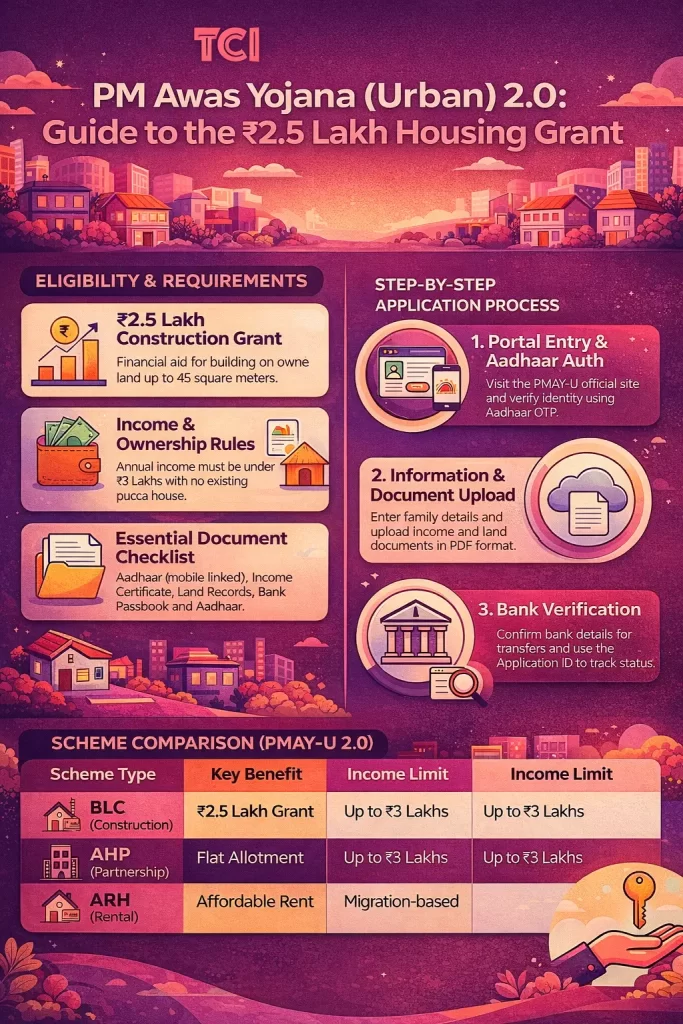
PMAY-U 2.0: Best Government-Backed Home Loan for First-Time Buyers
PMAY-U 2.0 is the most widely used government-backed housing loan scheme in India.
Key Benefits at a Glance
- Interest subsidy up to ₹1.80 lakh
- Applies to first ₹8 lakh of loan
- Loan tenure considered up to 12 years
- Subsidy credited directly to loan account
- Lower overall interest outgo
Income Eligibility
| Category | Annual Income |
| EWS | Up to ₹3 lakh |
| LIG | ₹3–6 lakh |
| MIG | ₹6–9 lakh |
Who Can Apply?
- First-time homebuyers only
- No pucca house anywhere in India
- Property value usually capped at ₹35 lakh
- Must be purchasing a residential unit
How the PMAY Interest Subsidy Actually Works (Simple Explanation)
Many buyers think PMAY gives cash. It doesn’t.
Here’s what really happens:
- You take a home loan from a bank
- Government pays interest subsidy upfront to the bank
- Bank reduces your loan principal
- You pay EMI on a lower amount
Result: Lower total interest + faster loan repayment
Read: Top Government Subsidy for Solar Panels in India – Complete Guide for Homeowners
PMAY-G: Government Housing Support for Rural Buyers
PMAY-G is meant for families in rural India who do not own a permanent home.
Benefits:
- ₹1.20–₹1.30 lakh for house construction
- Linked benefits for toilet, LPG, electricity
- Optional bank loan if extra funds are required
PMAY-G is not a loan scheme — it is a direct housing assistance program.
EMI Comparison: With vs Without Government Support
| Scenario | Loan | EMI | Total Benefit |
| Regular home loan | ₹25L | ₹22,490 | No subsidy |
| PMAY-U 2.0 | ₹25L | ₹21,000–21,500 | Saves up to ₹1.8L |
| PMAY-G | NA | NA | Direct housing grant |
Credit Linked Subsidy Scheme (CLSS) under PMAY
The Credit Linked Subsidy Scheme (CLSS) is the core component of PMAY (both Urban and earlier versions) that reduces the interest burden on home loans itself.
(Under PMAY-U 2.0, CLSS has been streamlined into the broader Interest Subsidy Scheme but still plays a significant role.)
How CLSS Works
- The government pays part of the interest directly to the lending institution at Net Present Value (NPV) — meaning your effective interest cost drops significantly.
- Earlier, CLSS had specific provisions for EWS/LIG at higher subsidy rates and extended to MIG categories; although some income categories and terms have evolved in PMAY-U 2.0, the principle of reducing interest remains central.
Typical Subsidy Structure (Legacy/CLSS-Era)
| Income Category | Subsidy Rate | Max Loan Eligible | Max Subsidy |
|---|---|---|---|
| EWS (≤ ₹3L) | ~6.5% | ₹6 lakh | Varies by NPV |
| LIG (₹3–6L) | ~4% | ₹9 lakh | Varies by NPV |
| MIG (₹6–18L) | ~3–4% | ₹12–18 lakh | Varies by NPV |
Benefits for Buyers
- Lower EMIs from day one of your loan.
- Works for new construction, purchase, and certain home improvements.
- Encourages formal, documented housing financing.
Government-Backed Home Loans – A Comparison
| Scheme | Target Group | Main Benefit | Eligibility Focus |
|---|---|---|---|
| PMAY-U 2.0 | Urban EWS/LIG/MIG | Up to ₹1.80L interest subsidy on home loans | Income limits & no prior pucca house |
| Credit Linked Subsidy Scheme (CLSS) | Urban/Previous PMAY | Interest reduction via subsidy to bank | Income-based sliding subsidy |
| PMAY-G | Rural households | Direct assistance + optional subsidised loans | Disadvantaged rural households |
Read: Top 8 Central Government Schemes For Housewives
Best Banks for Government-Backed Home Loans
These lenders have strong PMAY integration and faster subsidy processing:
- State Bank of India (SBI) – Best overall
- HDFC Ltd – Smooth digital processing
- ICICI Bank – Fast approvals
- Bank of Baroda – Lower interest for salaried buyers
- PNB Housing Finance – Affordable housing focus
Current Home Loan Interest Rates (First-Time Buyers)
| Lender Type | Interest Rate Range |
| PSU Banks | 8.35% – 8.75% |
| Private Banks | 8.50% – 9.25% |
| HFCs | 8.60% – 9.50% |
Rates depend on:
- Credit score
- Income stability
- Loan amount
- Property type
Eligibility Checklist for First-Time Buyers
✔ Age: 21–65 years
✔ Stable income
✔ Credit score: 700+ preferred
✔ First-time home ownership
✔ Legally approved property
✔ PMAY income limits met
Documents Required for Government-Backed Home Loans in India
Identity & Address
Income Proof
- Salary slips / ITR (2–3 years)
- Bank statements
Property
- Agreement to sell
- Approved layout plan
PMAY
- First-time buyer affidavit
- Income declaration
FAQs – Government-Backed Home Loans in India
Who qualifies as a first-time homebuyer under PMAY?
Anyone whose family does not own a pucca house anywhere in India.
Is PMAY subsidy paid in cash?
No. The subsidy is credited directly to the home loan account, reducing principal.
Does PMAY-U 2.0 reduce EMIs immediately?
Not always. The main benefit is lower total interest; EMIs or tenure may be adjusted by the lender.
Can first-time homebuyers get zero processing fee loans?
Yes. Many banks periodically offer zero or discounted processing fees, especially during festive seasons or for PMAY-linked loans. These are lender promotions, not government mandates.
How can a first-time buyer refinance a home loan?
Refinancing is done by transferring the loan to another lender offering a lower interest rate. PMAY subsidy, if already availed, cannot be claimed again, but refinancing can still reduce future interest costs.
What is the average loan tenure offered to first-time homebuyers?
Most lenders offer 20–30 years tenure, depending on the borrower’s age and income stability. Longer tenures lower EMIs but increase total interest paid.
Can PMAY benefits be claimed more than once?
No. PMAY benefits are one-time per family across all central housing schemes.
Final Takeaway
If you’re a first-time homebuyer in India, government-backed home loans under PMAY-U 2.0 can reduce your cost of ownership by ₹1–2 lakh or more.
When combined with the right bank, interest rate, and tenure, PMAY remains the most powerful home-buying support scheme in India in 2026.
Source: https://pmay-urban.gov.in/
Interesting Read
