How Do You Get a Legal Heir Certificate in India? A Detailed Guide
A death in the family sets off a wave of paperwork nobody feels ready for. Somewhere in that pile sits the legal heir certificate in India, a document most banks, pension offices, and property registrars won’t move forward without.
The certificate takes 30 to 45 days under most states’ Right to Service Act, and costs ₹500 to ₹1,500 out of pocket once you count the application fee, stamp paper, and notarization (Right to Information Wiki, 2026). It won’t settle a property dispute or divide an estate. It puts on record who the deceased’s surviving heirs are.
Key Takeaways
- A legal heir certificate is issued by the Tehsildar, SDM, or Revenue Department, not a court, and usually takes 30-45 days, with field verification alone taking 15-30 days of that window
- It’s different from a succession certificate, which comes from a civil court and carries more legal weight for movable assets
- Total cost is typically ₹500-1,500, including notary and stamp paper charges
- Most states now offer online applications through portals like Aaple Sarkar (Maharashtra), Seva Sindhu (Karnataka), and e-Sathi (Uttar Pradesh)
- Leaving an heir off the application, even one who’s estranged or abroad, can cause problems years later
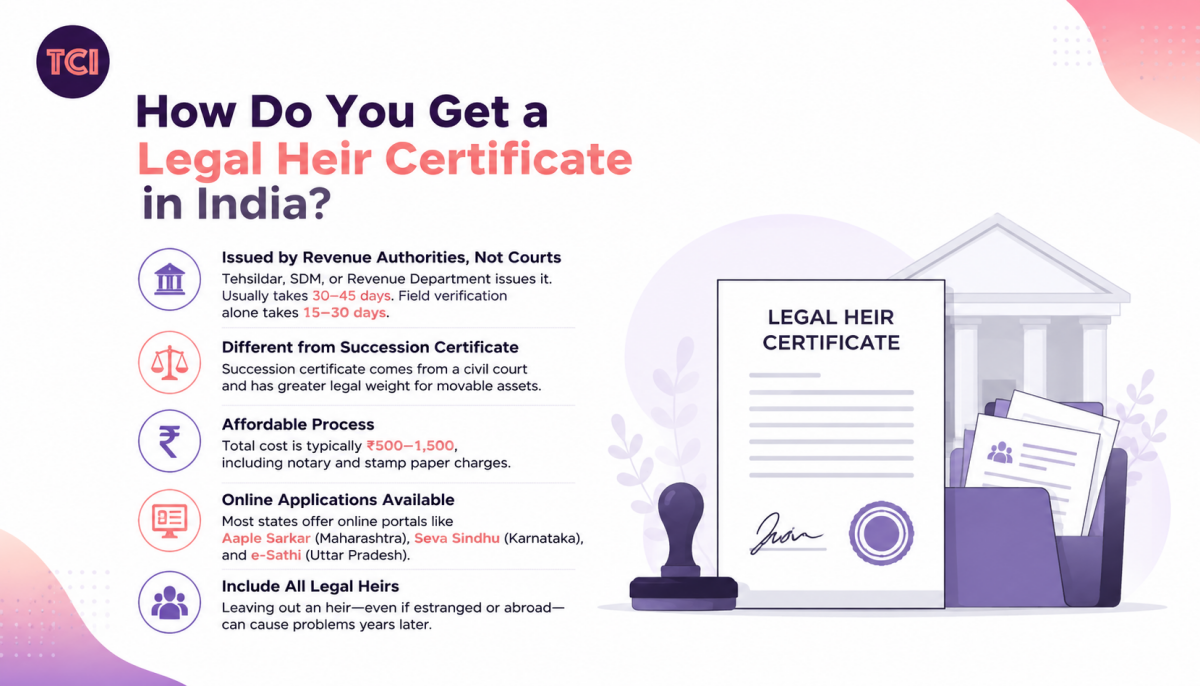
Table of Contents
The Legal Heir Certificate’s Real Job
A legal heir certificate is an administrative record, issued by a Tehsildar, Sub-Divisional Magistrate, or the Revenue Department, that names the surviving family members of someone who has died. It confirms who the heirs are. It doesn’t decide how much each heir gets, and it isn’t a substitute for a will or a court ruling on inheritance.
Banks, insurers, and government departments ask for it because they need something official on file before releasing money or transferring an asset to a family member. It functions as a formally verified family tree that institutions can rely on before they release funds.
When Do You Need A Legal Heir certificate In India?
Most people encounter this certificate the first time they try to do one of the following after a death in the family:
- Transfer property or land into the heirs’ names when there’s no will
- Close or transfer bank accounts and fixed deposits. India’s Reserve Bank lets banks settle claims up to ₹1.5 lakh with simplified proof, but larger balances usually need this certificate at minimum
- Claim pension, gratuity, or provident fund dues left behind by a deceased employee
- Collect insurance payouts where no nominee was registered
- Transfer a ration card, electricity connection, or vehicle registration
- Apply for a compassionate government appointment, in states where that scheme exists
If a will exists, a probate or the executor’s authority may cover some of these steps instead. Without one, the legal heir certificate is usually the first document any office asks for.
Legal Heir Certificate In India vs. Succession Certificate
Most people get tripped up here. It’s worth getting the distinction right before you start.
| Specifics | Legal Heir Certificate | Succession Certificate |
|---|---|---|
| Issued by | Tehsildar / SDM / Revenue Department | Civil court |
| Confirms | Who the surviving heirs are | Who has the legal right to inherit debts, securities, and movable assets |
| Typical use | Pensions, small bank claims, utility transfers, property mutation (varies by state) | Larger or disputed bank holdings, shares, and other movable assets |
| Timeline | 30-45 days under most state RTS Acts | Often several months, since it’s a court process |
| Legal strength | Administrative, faster to obtain | Stronger legal standing, backed by judicial scrutiny |
A related but separate document, the Surviving Member Certificate used in Delhi and a few other states, records household membership without ruling on inheritance shares either.
If your family situation is straightforward, the legal heir certificate is usually enough. If there’s a large estate or any disagreement among relatives, expect banks or courts to push for a succession certificate on top of it.
Legal Heirs Under Indian Succession Law
Under Indian succession law, the closest legal heirs are generally:
- The deceased’s spouse
- Children, sons and daughters, treated equally under the Hindu Succession Act
- Parents of the deceased, where the spouse and children aren’t available
The exact ranking and share each heir receives depends on which personal law applies (Hindu, Muslim, Christian, or another) and whether a valid will exists. Getting it right the first time matters here, since correcting a certificate later means going through verification again.
Documents You’ll Need For A Legal Heir certificate In India
Requirements shift slightly by state, but nearly every office asks for the same core set:
- Death certificate of the deceased, original plus a photocopy
- Identity proof of the applicant: Aadhaar, voter ID, or passport
- Address proof for both the applicant and, where required, the deceased
- Proof of relationship to the deceased: birth certificate, marriage certificate, or ration card
- Self-declaration affidavit, sworn on stamp paper, listing every surviving heir
- Photographs of the heirs (required in some states)
- Witness affidavit, in states that require independent verification of the family details
Property documents are usually optional at this stage, but including them can speed up the field inquiry.
How to Apply, Step by Step
- Get the death certificate first. Nothing else moves without it. Turnaround varies widely by state. Andhra Pradesh runs about 7-11 days, Kerala and Delhi can be as fast as 3-7 days, while Bihar sometimes takes up to two weeks (Death Certificate Download, 2026). Check your own state’s portal rather than assuming a national average.
- Choose your route: online or in person. Most states now run this through an e-district-style portal.
- Fill out the application accurately, listing every surviving heir, including those living abroad or out of touch.
- Attach the required documents and the notarized affidavit.
- Pay the fee, which is small regardless of route.
- Sit through field verification. A local revenue official, often called a lekhpal, Talathi, or Village Administrative Officer, checks the details, sometimes by visiting the neighborhood.
- Download or collect the certificate once approved, and request a few certified copies while you’re at it.
State Portals Worth Knowing
| State | Portal |
|---|---|
| Maharashtra | Aaple Sarkar (aaplesarkar.mahaonline.gov.in) |
| Karnataka | Seva Sindhu (sevasindhu.karnataka.gov.in) |
| Tamil Nadu | TN e-Sevai / cmschemes.tn.gov.in |
| Delhi | e-District Delhi (edistrict.delhigovt.nic.in) |
| Uttar Pradesh | e-Sathi |
| Rajasthan | e-Mitra |
| Andhra Pradesh | MeeSeva |
Offline applications remain an option everywhere. Walk into the Tehsildar’s office covering the area where the deceased last lived.
NRIs face an extra wrinkle. Some states require the applicant to be a local resident, so an NRI heir usually can’t file directly in their own name. A resident family member can be authorized through a properly drafted power of attorney to handle submission and follow-up instead.
Read: Power of Attorney for NRIs: The Complete Guide
Timeline and Costs
Most states commit to 30 to 45 days under their Right to Service Act, and field verification by the local revenue official eats up 15 to 30 days of that window on its own (RTI Wiki, 2026). Maharashtra runs faster in practice: the process there wraps up in 15 to 30 days, with the Talathi’s local inquiry usually the longest single step (1acre.in, 2026).
Costs stay modest almost everywhere:
| Item | Typical Cost |
|---|---|
| Application fee | ₹2 – ₹50 |
| Stamp paper for affidavit | ₹10 – ₹100 |
| Notary charges | ₹100 – ₹500 |
| Certified copies (each) | ₹20 – ₹50 |
| Total out-of-pocket | ₹500 – ₹1,500 |
Costs climb only if you bring in an agent or lawyer to manage the paperwork. Worth it if the family is scattered across cities, less necessary if everyone’s nearby and in agreement.
Disputes Among Heirs
Not every family agrees on who counts as an heir. If another heir objects, disputing who should be listed or how shares should work, the Tehsildar’s office won’t referee that fight. The application stalls until the dispute is resolved elsewhere, often pushing families toward a civil court or a formal succession certificate instead.
This is the practical limit of the certificate. It works when everyone agrees, and stalls when they don’t.
Most people don’t need a lawyer for a straightforward case. They file directly through the Tehsildar’s office or the state’s online portal. A lawyer earns their fee once a dispute shows up among heirs, or once the estate is large enough to need a succession certificate too.
Correcting a Certificate That’s Missing an Heir
If an heir gets left off, deliberately or by oversight, the fix is to apply for correction or reissuance, submitting fresh proof of the relationship. The authority usually re-verifies the family details before amending the record, so expect this to take nearly as long as the original application.
Practical Tips Before You Apply
- List every heir accurately, even ones abroad or estranged. Leaving someone out can resurface as a legal headache during a property sale years down the line.
- Order multiple certified copies up front. Banks, insurers, and the sub-registrar’s office will each want their own.
- Confirm your state’s exact portal name before applying. Meeseva, Aaple Sarkar, Seva Sindhu, and e-Sathi aren’t interchangeable, and applying on the wrong one wastes time.
- Budget for a succession certificate separately if the estate is large or contested; the legal heir certificate alone won’t satisfy every bank or registrar in that scenario.
- Keep the death certificate handy in digital form (DigiLocker, where available). Nearly every subsequent step asks for it again.
Disclaimer: This article is for general information only and isn’t a substitute for legal advice. Procedures, fees, and document requirements vary by state and change periodically. Confirm current requirements with your local Tehsildar’s office, Revenue Department, or state e-district portal before applying.
Sources: bankbazaar
