When is PAN Card Mandatory? Full List of 16 Transactions
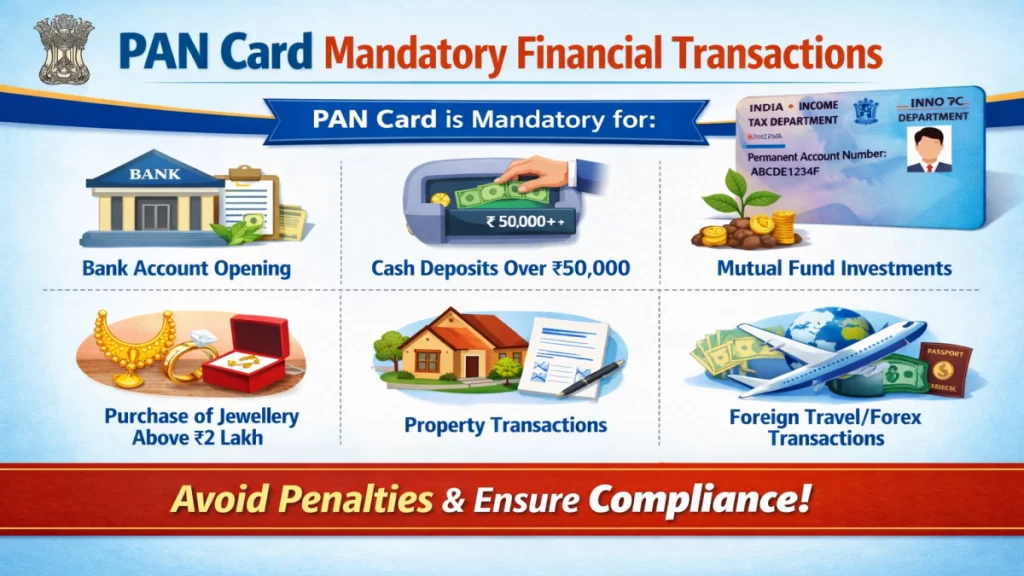
What are some of the PAN card mandatory transactions? From opening a bank account to sales or purchase of properties there are 16 financial transactions that require you to quote PAN.
Quick Answer: Under Rule 114B of the Income Tax Rules, 1962, quoting a Permanent Account Number (PAN) is mandatory for 16 categories of financial transactions in India. These include buying any motor vehicle (except two-wheelers), opening a bank or demat account, applying for a credit or debit card, making cash deposits above ₹50,000 in a single day, purchasing mutual funds or fixed deposits above ₹50,000, buying immovable property worth ₹10 lakh or more, and filing income tax returns. Not quoting PAN where required attracts a penalty of ₹10,000 under Section 272B of the Income Tax Act, 1961, and TDS at 20% under Section 206AA.
PAN Card Mandatory Transactions: What This Article Covers
This article explains:
- The complete list of transactions where quoting PAN is mandatory under Indian law
- The exact monetary thresholds for each transaction
- Which transactions require PAN or Aadhaar (not PAN alone)
- What happens if you fail to quote PAN
- How to complete a mandatory transaction without a PAN
- Changes to PAN thresholds proposed under the Draft Income Tax Rules, 2026
If you are new to PAN cards, read What is PAN Card? Meaning, Full Form, and Uses first.
What Makes PAN Mandatory? The Legal Framework
PAN stands for Permanent Account Number. It is a 10-character alphanumeric identifier issued by the Income Tax Department of India to every taxpayer.
Two provisions of Indian law create the obligation to quote PAN:
Section 139A of the Income Tax Act, 1961 requires every person who is required to file income tax returns — or who carries out specified financial transactions above prescribed limits — to obtain a PAN. This section also empowers the government to specify which transactions require PAN.
Rule 114B of the Income Tax Rules, 1962 is the specific rule that lists every transaction category where quoting PAN is compulsory. It defines the type of transaction, the monetary threshold (where applicable), and the party responsible for collecting the PAN. The Central Board of Direct Taxes (CBDT) periodically amends Rule 114B by issuing notifications.
Who enforces this? The collecting entity — the bank, mutual fund house, property registrar, hotel, or car dealer — is legally required to collect your PAN before completing the transaction. If the collecting entity fails to do so, they may themselves face penalties.
Full List of PAN Card Mandatory Transactions
The 16 transaction categories below come directly from Rule 114B of the Income Tax Rules, 1962. Thresholds shown are the current applicable limits as of March 2026, unless a proposed change under the Draft Income Tax Rules 2026 is noted.
1. Sale or Purchase of a Motor Vehicle (Other Than Two-Wheelers)
- Who it applies to: Buyer and seller of any motor vehicle, excluding two-wheelers.
- Threshold: Any value. No minimum amount. The rule applies to every sale or purchase.
- Legal provision: Rule 114B(a), Income Tax Rules, 1962.
- Exception: Two-wheeled vehicles are explicitly exempt from this rule.
- 2026 Update (Proposed): The Draft Income Tax Rules, 2026 propose applying this rule only to vehicles valued at ₹5 lakh or more.
Why this matters in practice: PAN is collected by the car dealership or the Regional Transport Office (RTO) at the time of registration. Buyers often discover this requirement at the dealership, not before. If buying a used vehicle, PAN must be provided regardless of whether a dealer is involved.
2. Opening a Bank Account
- Who it applies to: Any individual, Hindu Undivided Family (HUF), or entity opening a new bank account.
- Threshold: Any value. No minimum deposit required.
- Legal provision: Rule 114B(b), Income Tax Rules, 1962.
- Exception: A Basic Savings Bank Deposit (BSBD) account — also known as a zero-balance account — can be opened without PAN by submitting Form 60 in its place.
- Applies to: Scheduled commercial banks, co-operative banks, and post offices.
Note: This rule applies to account opening, not to individual transactions within an existing account. Deposits, withdrawals, and transfers within an existing account have separate thresholds (see point 11 below).
3. Applying for a Credit Card or Debit Card
- Who it applies to: Any applicant for a credit card or debit card.
- Threshold: Any value. Applies regardless of the credit limit applied for.
- Legal provision: Rule 114B(c), Income Tax Rules, 1962.
- Applies to: Banks, non-banking financial companies (NBFCs), and any institution that issues credit or debit cards.
Note: This rule covers the application stage, not card usage. Once a card is issued, individual transactions do not separately require PAN quotation unless they fall under other Rule 114B categories.
4. Opening a Demat Account
- Who it applies to: Any individual or entity opening a demat (dematerialised) account to hold shares or securities.
- Threshold: Any value. No minimum portfolio size.
- Legal provision: Rule 114B(d), Income Tax Rules, 1962.
- Applies to: Depositories (NSDL, CDSL), depository participants, custodians of securities, and any SEBI-registered intermediary.
This rule makes PAN mandatory for every stock market investor in India, including those investing through brokers, investment apps, or direct mutual fund platforms.
5. Cash Payment at a Hotel or Restaurant Above ₹50,000
- Who it applies to: Any person paying for hotel accommodation, restaurant services, or both in cash.
- Threshold: Cash payments exceeding ₹50,000 per bill.
- Legal provision: Rule 114B(e), Income Tax Rules, 1962.
- Important clarification: This rule applies to cash payments only. Digital payments — UPI, credit card, net banking — do not trigger this requirement regardless of the amount.
- 2026 Update (Proposed): The Draft Income Tax Rules, 2026 propose raising this threshold to ₹1 lakh.
6. Cash Payment for Foreign Travel or Foreign Exchange Purchase Above ₹50,000
- Who it applies to: Any person making cash payments to a travel agent, tour operator, or foreign exchange dealer.
- Threshold: Cash payments exceeding ₹50,000 per transaction.
- Legal provision: Rule 114B(f), Income Tax Rules, 1962.
- Covers: Purchasing foreign currency, booking international air tickets, or paying for any overseas travel package in cash.
NRI note: When travelling to India and purchasing Indian rupees from authorised foreign exchange dealers, the threshold applies to the Indian rupee equivalent of the foreign currency being exchanged.
7. Fixed Deposit (Time Deposit) Above ₹50,000
- Who it applies to: Any person making a time deposit (fixed deposit) with a bank, co-operative bank, post office, or Nidhi company.
- Threshold: Deposits exceeding ₹50,000 on any single day, or deposits exceeding ₹5 lakh during a financial year across all accounts with the same institution.
- Legal provision: Rule 114B(g), Income Tax Rules, 1962.
- Applies to: Scheduled commercial banks, co-operative banks, post offices, and Nidhi companies.
Practical note: The annual aggregate threshold of ₹5 lakh means that multiple smaller deposits spread across a financial year can collectively trigger the PAN requirement.
8. Payment to a Mutual Fund Above ₹50,000
- Who it applies to: Any investor purchasing units of a mutual fund scheme.
- Threshold: Payment exceeding ₹50,000 in a single transaction.
- Legal provision: Rule 114B(h), Income Tax Rules, 1962.
- Applies to: All mutual fund schemes including equity, debt, hybrid, and ELSS (Equity Linked Savings Scheme) funds.
- Important: This threshold applies per transaction, not annually. Multiple SIP (Systematic Investment Plan) instalments are each evaluated individually.
9. Purchase of Bonds or Debentures Above ₹50,000
- Who it applies to: Any investor purchasing bonds or debentures from a company or institution.
- Threshold: Payment exceeding ₹50,000 per transaction.
- Legal provision: Rule 114B(i), Income Tax Rules, 1962.
- Covers: Corporate bonds, non-convertible debentures (NCDs), and bonds issued by financial institutions.
10. Purchase of RBI Bonds or RBI Savings Certificates Above ₹50,000
- Who it applies to: Any investor purchasing bonds or savings certificates issued by the Reserve Bank of India (RBI).
- Threshold: Payment exceeding ₹50,000 per transaction.
- Legal provision: Rule 114B(j), Income Tax Rules, 1962.
- Covers: RBI Floating Rate Savings Bonds, RBI 7.75% Savings (Taxable) Bonds, and other government securities issued through the RBI.
11. Cash Deposit Above ₹50,000 in a Single Day
- Who it applies to: Any person depositing cash into an account at a bank, co-operative bank, or post office. Threshold: Cash deposits exceeding ₹50,000 on a single day.
- Legal provision: Rule 114B(k), Income Tax Rules, 1962.
- 2026 Update (Proposed): The Draft Income Tax Rules, 2026 propose replacing the per-day threshold with an annual aggregate threshold of ₹10 lakh or more across all accounts in a financial year.
This is separate from the Rule 114BA requirement (see Section 5 below) which covers aggregate cash deposits above ₹20 lakh in a year across all accounts.
12. Purchase or Sale of Shares in an Unlisted Company Above ₹1 Lakh
- Who it applies to: Any buyer or seller of shares in a company not listed on a recognized stock exchange. Threshold: Transaction value exceeding ₹1 lakh.
- Legal provision: Rule 114B(l), Income Tax Rules, 1962.
- Important clarification:
- This rule applies to unlisted company shares only. Shares of companies listed on BSE or NSE are bought through demat accounts, which already require PAN at the account-opening stage.
13. Purchase or Sale of Immovable Property Above ₹10 Lakh
- Who it applies to: Buyer and seller of land, building, flat, apartment, or any immovable property.
- Threshold: Property value of ₹10 lakh or more. Legal provision: Rule 114B(m), Income Tax Rules, 1962.
- Additional obligation: Under Section 194-IA of the Income Tax Act, 1961, the buyer must also deduct TDS at 1% of the transaction value when purchasing immovable property worth ₹50 lakh or more, for which PAN of both buyer and seller is required.
- 2026 Update (Proposed): The Draft Income Tax Rules, 2026 propose raising the PAN threshold for immovable property to ₹20 lakh.
14. Payment for Life Insurance Premium Above ₹50,000 Per Year
- Who it applies to: Any policyholder paying life insurance premiums.
- Threshold: Annual premium payment exceeding ₹50,000 in a financial year.
- Legal provision: Rule 114B(n), Income Tax Rules, 1962.
- Applies to: All life insurance companies including LIC (Life Insurance Corporation of India) and private insurers.
Note: This threshold refers to the total annual premium, not any single instalment. If you pay quarterly instalments of ₹15,000, totalling ₹60,000 annually, PAN must be quoted.
15. Cash Payment for Travel Above ₹50,000
- Who it applies to: Any person making cash payments to a travel agent or travel operator.
- Threshold: Cash payments exceeding ₹50,000 per transaction.
- Legal provision: Rule 114B(o), Income Tax Rules, 1962.
- Covers: Air tickets, railway tickets, hotel bookings, and complete tour packages when paid in cash.
16. Cash Purchase or Sale of Goods or Services Above ₹2 Lakh (Single Transaction)
- Who it applies to: Any person involved in the cash purchase or sale of goods or services not covered by any other Rule 114B category.
- Threshold: ₹2 lakh or more in a single cash transaction.
- Legal provision: Rule 114B(p), Income Tax Rules, 1962.
- Important: This is a catch-all provision. It covers any transaction in cash above ₹2 lakh that does not fall under items 1 through 15 above.
Examples: Paying cash for gold or jewelry above ₹2 lakh, purchasing high-value electronics in cash, or making any large cash payment to a business.
Transactions Where PAN or Aadhaar is Mandatory
Rule 114BA of the Income Tax Rules, 1962 — added by CBDT Notification No. 37/2021 — requires individuals to quote either PAN or Aadhaar for the following high-value cash transactions:
1. Cash deposits or withdrawals of ₹20 lakh or more in a financial year This limit is calculated in aggregate across all accounts held by the same person with a banking company, co-operative bank, or post office — not per account.
2. Opening a current account or cash credit account Any current account or cash credit account opened with a banking company, co-operative bank, or post office requires PAN or Aadhaar.
How this works:
- If you hold a PAN, you must quote your PAN. You cannot substitute Aadhaar if you have a PAN.
- If you do not hold a PAN, you must quote your Aadhaar number.
- Non-resident individuals and foreign companies are exempt from the Rule 114BA requirement under specific conditions.
When is PAN Mandatory for NRIs?
Non-Resident Indians (NRIs) who earn income from Indian sources, invest in Indian financial markets, or own property in India are not exempt from PAN obligations.
Specific NRI transactions where PAN is mandatory:
- Opening an NRE (Non-Resident External) or NRO (Non-Resident Ordinary) bank account
- Investing in Indian stocks, mutual funds, or fixed deposits
- Buying or selling immovable property in India above ₹10 lakh
- Filing an Indian income tax return
- Earning rental income or dividend income from Indian sources
- Repatriating funds from India above prescribed limits
Forms applicable to NRIs: NRIs apply for a PAN card using Form 49A (Indian passport holders) or Form 49AA (foreign nationals, OCI cardholders, Persons of Indian Origin).
For a complete walkthrough of the application process, see our guide: PAN Card for NRIs – How to Apply from Abroad.
When is PAN Mandatory for Businesses?
All business entities in India — including sole proprietorships, Hindu Undivided Families (HUFs), partnership firms, limited liability partnerships (LLPs), private limited companies, and trusts — must hold a PAN.
Business transactions where PAN is specifically required:
- At the time of business registration or incorporation
- For filing TDS (Tax Deducted at Source) returns under Chapter XVII-B of the Income Tax Act, 1961
- For paying advance tax and self-assessment tax
- For salary payments above the basic exemption limit
- When opening current accounts with banks
- When making payments subject to TDS — including rent (Section 194-I), professional fees (Section 194J), and contractor payments (Section 194C)
- For all Rule 114B transactions listed above, to the extent applicable
For entity-specific PAN requirements, see our Complete Guide to PAN Card in India.
PAN Card Mandatory Transaction – PAN is Always Required for Income Tax Return Filing
Regardless of the transaction thresholds above, a valid and operative PAN is always required for:
- Filing an Income Tax Return (ITR) — any ITR form, any income level
- All written or digital correspondence with the Income Tax Department
- Payment of advance tax (Section 208) and self-assessment tax (Section 140A)
- TDS certificates (Form 16, Form 16A)
- Claiming income tax refunds
- Responding to income tax notices
Inoperative PAN: A PAN that has not been linked to Aadhaar becomes inoperative under CBDT Circular No. 3/2023. Using an inoperative PAN results in TDS being deducted at the higher rate of 20% under Section 206AA, delayed or rejected ITR processing, and non-issuance of refunds.
What Happens If You Don’t Quote PAN?
Failing to quote PAN in a mandatory transaction has three direct legal consequences:
Consequence 1: Penalty of ₹10,000 Under Section 272B
Section 272B of the Income Tax Act, 1961 imposes a flat penalty of ₹10,000 per default. A “default” under this section means:
- Failing to obtain a PAN when required to do so
- Failing to quote PAN in a transaction where it is compulsory
- Quoting an incorrect PAN (including typographical errors)
The Assessing Officer may issue this penalty for each individual instance of non-compliance.
Consequence 2: TDS at 20% Under Section 206AA
Section 206AA of the Income Tax Act, 1961 mandates that where a person fails to provide PAN, the deductor must apply TDS at 20% or the rate specified in the relevant section, whichever is higher.
For context: standard TDS rates range from 1% (property purchases under Section 194-IA) to 10% (professional services under Section 194J). A 20% rate represents a significantly higher deduction that cannot be reclaimed until the annual income tax return is processed.
Consequence 3: Transaction May Be Rejected
Banks, mutual fund registrars, property registration offices, and insurance companies are required by law to collect PAN before completing high-value transactions. In practice, non-compliance results in:
- Refusal to open a bank or demat account
- Rejection of a mutual fund purchase instruction
- Hold on property registration
- Rejection of a fixed deposit booking
Form 60: What to Submit If You Don’t Have a PAN
Form 60 is a declaration that can be submitted in place of PAN for most Rule 114B transactions. It is prescribed under Rule 114B of the Income Tax Rules, 1962.
Form 60 must include:
- Full name, date of birth, and address of the declarant
- Nature and monetary value of the transaction
- Reason for not holding a PAN (e.g., income below taxable limit)
- Estimated total income for the financial year
When Form 60 cannot be used:
- For filing an income tax return — PAN is mandatory without exception
- For opening a demat account — SEBI regulations require PAN specifically
- For applying for a credit or debit card — the issuing bank may refuse Form 60
- For NRE or NRO account opening — PAN or Aadhaar is compulsory
Important: Form 60 is not a permanent substitute for PAN. If the declarant later obtains a PAN, they must inform the relevant bank or institution within 30 days of PAN allotment.
Proposed Changes Under the Draft Income Tax Rules, 2026
The Ministry of Finance published the Draft Income Tax Rules, 2026 for public comment, with a feedback deadline of February 22, 2026. These rules are expected to come into effect from April 1, 2026 alongside the new Income Tax Act, 2025.
Status as of March 2026: The rules are proposed — not yet officially notified. Thresholds currently in force under Rule 114B, 1962 remain applicable until a formal CBDT notification is issued.
Proposed threshold changes:
| Transaction Category | Current Threshold (Rule 114B, 1962) | Proposed Threshold (Draft Rules, 2026) |
|---|---|---|
| Motor vehicle purchase/sale | Any value (non-two-wheeler) | ₹5 lakh and above |
| Cash deposit in bank (per day) | ₹50,000 per day | ₹10 lakh aggregate in a financial year |
| Cash withdrawal from bank | ₹50,000 per day | ₹10 lakh aggregate in a financial year |
| Cash payment at hotel/restaurant | Above ₹50,000 | Above ₹1 lakh |
| Purchase of immovable property | ₹10 lakh and above | ₹20 lakh and above |
Why the changes are proposed: The CBDT has stated that the objective is to reduce the compliance burden for routine low-value transactions while retaining scrutiny on genuinely high-value cash flows.
The current ₹50,000 cash deposit threshold, set years ago, covers a large volume of ordinary transactions and is seen as disproportionate relative to current income levels.
Also proposed from April 1, 2026: Aadhaar-only PAN applications — currently accepted under Section 139AA — will no longer be valid. All new PAN applications will require Aadhaar plus documentary proof of date of birth.
PAN 2.0: What It Means for Mandatory Transactions
The Income Tax Department announced the PAN 2.0 Project in November 2024. This project will consolidate all PAN-related services — application, update, reprint, correction — onto a single unified government portal with a QR code embedded in the upgraded PAN card.
What changes for mandatory transactions under PAN 2.0:
- PAN will become a common business identifier across government systems, integrating with the Ministry of Corporate Affairs (MCA), Goods and Services Tax Network (GSTN), and other regulatory databases.
- The verification of PAN during high-value transactions will become faster and more automated through the unified platform.
- Existing PAN holders will not be required to apply for a new card unless they wish to update their details.
Complete Quick-Reference Table: All Transactions Where PAN is Mandatory
| # | Transaction | Threshold | Rule / Section | PAN or Aadhaar Accepted? |
|---|---|---|---|---|
| 1 | Motor vehicle purchase/sale (non-two-wheeler) | Any value | Rule 114B(a) | PAN only |
| 2 | Bank account opening | Any value | Rule 114B(b) | PAN only (Form 60 exception for BSBD) |
| 3 | Credit/debit card application | Any value | Rule 114B(c) | PAN only |
| 4 | Demat account opening | Any value | Rule 114B(d) | PAN only |
| 5 | Cash payment at hotel/restaurant | Above ₹50,000 | Rule 114B(e) | PAN only |
| 6 | Cash payment for foreign travel/forex | Above ₹50,000 | Rule 114B(f) | PAN only |
| 7 | Fixed deposit (time deposit) | Above ₹50,000/day or ₹5 lakh/year | Rule 114B(g) | PAN only |
| 8 | Mutual fund purchase | Above ₹50,000 per transaction | Rule 114B(h) | PAN only |
| 9 | Purchase of bonds/debentures | Above ₹50,000 | Rule 114B(i) | PAN only |
| 10 | Purchase of RBI bonds | Above ₹50,000 | Rule 114B(j) | PAN only |
| 11 | Cash deposit at bank/post office | Above ₹50,000 in a single day | Rule 114B(k) | PAN only |
| 12 | Shares of unlisted companies | Above ₹1 lakh | Rule 114B(l) | PAN only |
| 13 | Purchase/sale of immovable property | ₹10 lakh and above | Rule 114B(m) | PAN only |
| 14 | Life insurance premium | Above ₹50,000 per financial year | Rule 114B(n) | PAN only |
| 15 | Cash payment for travel | Above ₹50,000 | Rule 114B(o) | PAN only |
| 16 | Cash purchase/sale of goods or services (catch-all) | Above ₹2 lakh per transaction | Rule 114B(p) | PAN only |
| 17 | Cash deposit/withdrawal (aggregate, all accounts) | ₹20 lakh or more in a financial year | Rule 114BA | PAN or Aadhaar |
| 18 | Opening a current account or cash credit account | Any value | Rule 114BA | PAN or Aadhaar |
| 19 | Income tax return filing | Any income | Section 139A, IT Act | PAN only (mandatory) |
PAN Card Mandatory Transitions: Frequently Asked Questions
What is PAN and why is it mandatory for financial transactions?
PAN (Permanent Account Number) is a 10-character alphanumeric identifier issued by the Income Tax Department of India. It is mandatory for specified financial transactions because it allows the government to track high-value money movement and link it to the corresponding taxpayer’s record, improving tax compliance and reducing the use of unaccounted cash.
Q: Is PAN mandatory for all bank transactions?
No. PAN is mandatory only at the time of opening a new bank account and when making cash deposits exceeding ₹50,000 in a single day. Routine transactions — including NEFT, RTGS, UPI transfers, and standing instructions — within an existing bank account do not separately require PAN quotation.
Is PAN mandatory for purchasing a two-wheeler?
No. Rule 114B(a) of the Income Tax Rules, 1962 explicitly exempts two-wheelers from the PAN requirement. Only four-wheelers and other motorized vehicles (excluding two-wheelers) are covered.
Can Aadhaar be used instead of PAN for all transactions?
No. Aadhaar can be used in place of PAN only for two specific situations under Rule 114BA: aggregate cash deposits or withdrawals exceeding ₹20 lakh in a financial year, and opening a current account or cash credit account. For most other mandatory transactions — including ITR filing, demat account opening, and property purchases — PAN is required specifically.
What is Form 60 and when can it be used?
Form 60 is a prescribed declaration form under Rule 114B of the Income Tax Rules, 1962. It can be submitted in lieu of PAN for most Rule 114B transactions by individuals whose income is below the taxable limit and who therefore do not hold a PAN. Form 60 cannot be used for filing income tax returns, opening demat accounts, or applying for credit cards.
What is the penalty for not quoting PAN in a mandatory transaction?
Under Section 272B of the Income Tax Act, 1961, a penalty of ₹10,000 is levied for each default. Additionally, under Section 206AA, TDS is deducted at a flat rate of 20% when PAN is not provided, compared to standard rates of 1%–10%.
Is PAN mandatory for NRIs who buy property in India?
Yes. Any person — resident or non-resident — purchasing immovable property in India valued at ₹10 lakh or more must quote their PAN. The buyer is also required to deduct TDS at 1% of the purchase price under Section 194-IA when the property value exceeds ₹50 lakh.
Will PAN requirements change in 2026?
The government has published Draft Income Tax Rules, 2026, proposing changes to several thresholds under Rule 114B. Key proposed changes include raising the immovable property threshold from ₹10 lakh to ₹20 lakh and replacing the ₹50,000 per-day cash deposit threshold with a ₹10 lakh annual aggregate threshold. These changes are proposed as of March 2026 and are not yet officially notified.
What happens if my PAN is inoperative?
If your PAN has not been linked to Aadhaar and has become inoperative, TDS will be deducted at 20% on applicable transactions under Section 206AA, you cannot file an income tax return, refunds will not be processed, and you may receive a deficiency notice from the Income Tax Department. You can reactivate your PAN by linking it with Aadhaar through the e-filing portal.
Official Sources and References
The information in this article is based on the following official government sources:
- Income Tax Act, 1961 — Section 139A (PAN obligation), Section 272B (penalty for non-compliance), Section 206AA (TDS without PAN)
- Income Tax Rules, 1962 — Rule 114B (mandatory transactions), Rule 114BA (PAN or Aadhaar transactions)
- CBDT Notification No. 37/2021 — Introduction of Rule 114BA (PAN or Aadhaar for ₹20 lakh transactions)
- CBDT Circular No. 3/2023 — Guidelines on inoperative PAN
- Draft Income Tax Rules, 2026 — Proposed threshold revisions (public comment closed February 22, 2026)
- PAN 2.0 Project announcement — Ministry of Finance / Income Tax Department, November 2024
For the most current notifications and circulars, visit the official Income Tax Department website at incometax.gov.in.
Related Articles
- What is PAN Card? Meaning, Full Form, and Uses
- PAN Number Meaning – What Does Each Character Tell You?
- Instant PAN Card: Apply Online, Check Status, Download PDF
- PAN Card Name Correction Guide – After Marriage, Spelling, Father Name
- PAN Card: Guide For Individuals, NRIs, And Businesses
Editorial Note: This article is written for informational purposes only and does not constitute legal or tax advice. The thresholds and provisions listed are based on the Income Tax Act, 1961 and Income Tax Rules, 1962 as in force in March 2026. Proposed changes under the Draft Income Tax Rules, 2026 are clearly labelled as proposals and are not yet law. For advice specific to your tax situation, consult a qualified chartered accountant (CA) or tax professional registered with the Institute of Chartered Accountants of India (ICAI).
