PAN Card Vs Aadhaar Card – Key Differences Explained
A complete guide to understanding the difference between PAN Card and Aadhaar Card — what they are, who issues them, where you need each, and how they work together.
If you have ever been confused about when to use your PAN Card and when to use your Aadhaar Card — you are not alone. Millions of Indians carry both, use both, but are not always sure what makes them different.
The short answer: PAN Card is your tax identity. Aadhaar Card is your personal identity. One is issued by the Income Tax Department for financial and tax purposes. The other is issued by UIDAI and serves as universal proof of who you are.
This article explains every key difference between PAN Card and Aadhaar Card in simple language, backed by official government sources. It is part of our Complete PAN Card Guide for Individuals, NRIs, and Businesses.
Table of Contents
What is a PAN Card?
PAN stands for Permanent Account Number. It is a 10-character alphanumeric code issued by the Income Tax Department of India to any person — individual, company, firm, or trust — who applies for it. For a full breakdown of what PAN is and how it works, see: What is PAN Card? Meaning, Full Form, and Uses.
Official definition (Income Tax India): PAN is a ten-digit alphanumeric number, issued in the form of a laminated card, by the Income Tax Department, to any person who applies for it or to whom the department allots the number.
Quick facts about PAN Card
- Issued by: Income Tax Department, Government of India
- Format: 10-character alphanumeric (e.g., ABCDE1234F)
- Who can get it: Indian residents, NRIs, companies, HUFs, trusts, foreign nationals with Indian financial transactions
- Cost: Free for instant e-PAN (with Aadhaar); ₹66–₹1,017 for physical card depending on delivery mode
- Validity: Lifetime — once issued, it never expires
- How many per person: Only one — holding two PANs attracts a ₹10,000 penalty under Section 272B
- Governing law: Income Tax Act, 1961
- Apply via: Income Tax Portal, NSDL/Protean eGov, or UTIITSL
Source: incometaxindia.gov.in — Income Tax Department, Government of India
What is an Aadhaar Card?
Aadhaar is a 12-digit unique identification number issued by UIDAI (Unique Identification Authority of India) to every resident of India. It is backed by your biometric data — fingerprints, iris scans, and photograph — making it one of the most secure identity systems in the world.
Official definition (UIDAI): Aadhaar number is a 12-digit random number issued by the UIDAI to the residents of India after satisfying the verification process. Any individual, irrespective of age and gender, who is a resident of India, may voluntarily enrol to obtain an Aadhaar number.
Quick facts about Aadhaar Card
- Issued by: UIDAI (Unique Identification Authority of India), Ministry of Electronics & IT
- Format: 12-digit numeric (e.g., 1234 5678 9012)
- Who can get it: All residents of India — any age, any gender; resident foreign nationals who have lived in India for 182+ days
- Cost: Enrolment is completely free of charge
- Validity: Lifetime — does not expire; biometrics can be updated
- How many per person: Only one — uniqueness guaranteed through biometric de-duplication
- Governing law: Aadhaar (Targeted Delivery of Financial and Other Subsidies, Benefits and Services) Act, 2016
- Apply via: Aadhaar Enrolment Centres (in-person visit required for biometrics)
Source: uidai.gov.in — Unique Identification Authority of India, Government of India
UIDAI data: Over 1.44 billion Aadhaar numbers have been generated as of early 2026. Approximately 99% of India’s adult population is enrolled.
PAN Card vs Aadhaar Card: At a Glance
The table below covers every major difference between a PAN Card and an Aadhaar Card, verified against official government sources.
| Feature | PAN Card | Aadhaar Card |
| Full Name | Permanent Account Number | Aadhaar — means ‘foundation’ in Sanskrit |
| Issuing Authority | Income Tax Department, Govt of India | UIDAI, Ministry of Electronics & IT, Govt of India |
| Number Length | 10 characters (alphanumeric) | 12 digits (numeric only) |
| Example | ABCDE1234F | 1234 5678 9012 |
| Who Can Apply | Residents, NRIs, companies, trusts, foreign nationals with Indian financial dealings | All residents of India (any age); resident foreign nationals (182+ days stay) |
| Primary Purpose | Tax identity — track financial transactions & prevent tax evasion | Personal identity — universal proof of who you are |
| Biometrics Stored? | No biometric data | Yes — fingerprints, iris scans, photograph |
| Proof of Address? | No — does not serve as address proof | Yes — Aadhaar includes your current address |
| For Children? | Yes — minors can apply (parents sign) | Yes — free enrolment for any age, including newborns |
| For Companies? | Yes — companies, firms, HUFs, trusts must have PAN | No — only for individual residents |
| Enrolment Cost | ₹66–₹1,017 (free for instant e-PAN via Aadhaar) | Free of charge |
| Apply Online? | Yes — Income Tax Portal, NSDL, UTIITSL | No — must visit an Aadhaar Enrolment Centre in person |
| Validity | Lifetime (never expires) | Lifetime (biometrics can be updated) |
| Governing Law | Income Tax Act, 2025 | Aadhaar Act, 2016 |
| Used for Tax Filing? | Yes — mandatory for income tax returns (ITR) | Can substitute PAN under Section 139AA (individuals) |
| Used for KYC? | Yes — widely used for financial KYC | Yes — accepted as primary KYC document |
| Used as Address Proof? | No | Yes — widely accepted |
| Used as ID Proof? | Yes — accepted as identity proof | Yes — accepted as identity proof |
| Can be Linked? | Must be linked with Aadhaar (mandatory) | Must be linked with PAN (mandatory) |
All data above verified from: incometaxindia.gov.in, uidai.gov.in, and proteantech.in
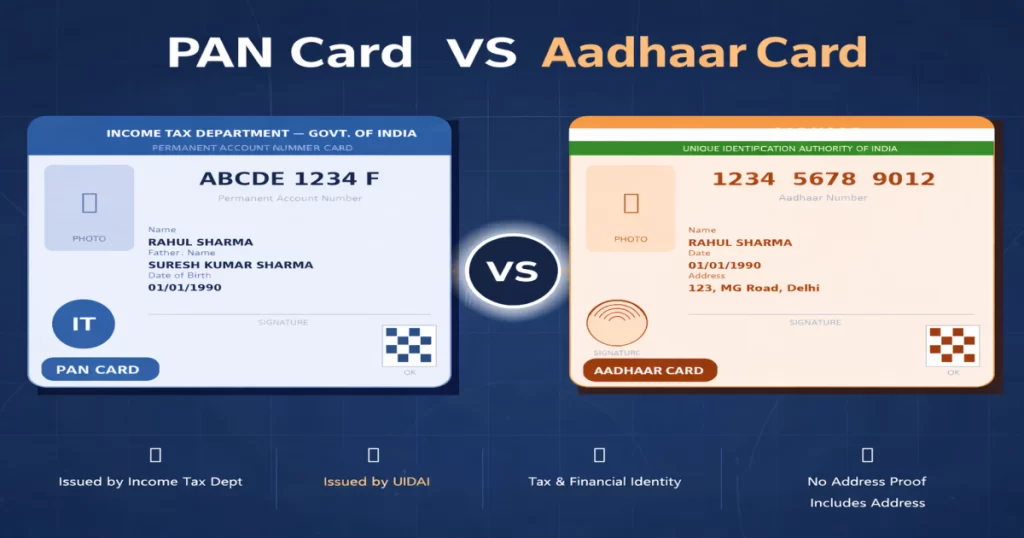
PAN Card vs Aadhaar Card: Key Differences Explained in Detail
1. Purpose: Tax Identity vs Personal Identity
This is the most fundamental difference.
PAN Card exists purely to track financial and tax-related transactions. When you earn income, buy property, invest in mutual funds, or make large cash deposits, your PAN is how the Income Tax Department knows it was you. The primary goal is to prevent tax evasion and bring high-value transactions under tax scrutiny.
Aadhaar Card exists to prove who you are. UIDAI describes it as a universal identity platform — one number that can be used across all government services, banks, and private services to verify your identity quickly and digitally. Because it is backed by biometrics, it is extremely difficult to fake or duplicate.
PAN = tax number. Aadhaar = identity number. Both are important, but for very different reasons.
2. Who Issues It?
PAN Card is issued by the Income Tax Department, Government of India. The actual processing is done by two authorised agencies: Protean eGov Technologies Limited (formerly NSDL) and UTIITSL (UTI Infrastructure Technology and Services Limited).
Aadhaar Card is issued by UIDAI — the Unique Identification Authority of India — which operates under the Ministry of Electronics and Information Technology, Government of India.
3. The Number Format Is Completely Different
PAN is a 10-character code combining letters and numbers. The format follows a specific structure: the first three characters are alphabetic series (e.g., ABC), the fourth character indicates the type of taxpayer (P for individual, C for company, H for HUF, etc.), the fifth character is usually the first letter of the applicant’s surname, the next four are sequential numbers, and the last character is a check letter. Example: ABCDE1234F. For a full character-by-character breakdown, see: PAN Number Meaning: Decode Guide for Individuals and Entities.
Aadhaar is a 12-digit purely numeric number, randomly generated. There is no embedded information in the number — it is not structured like PAN. The only check is the last digit, which is a Verhoeff algorithm check digit. Example: 1234 5678 9012.
4. Aadhaar Has Biometrics; PAN Does Not
This is a major technical difference. When you enrol for Aadhaar, UIDAI collects your photograph, all 10 fingerprints, and both iris scans. These are stored in the Central Identities Data Repository (CIDR) — a secure, encrypted database. When you authenticate using Aadhaar, your biometrics are verified in real time.
PAN Card has no biometric component. It only contains demographic information: your name, date of birth, father’s name, and PAN number. It does have your photograph and signature, but these are not digitally linked to a biometric database.
Because Aadhaar uses biometrics, it is a much stronger proof of identity than PAN. PAN is primarily a financial identifier, not an identity verifier in the biometric sense.
5. Who Can Apply?
PAN is available to almost any person or entity that conducts financial transactions in India — individuals (including minors), companies, partnership firms, HUFs (Hindu Undivided Families), trusts, NGOs, foreign nationals who invest in India, and even non-residents (NRIs). There is no age restriction.
Aadhaar is for residents of India only. Any individual of any age — including newborns — can enrol. Foreign nationals who have resided in India for 182 days or more in the 12 months immediately before enrolment can also apply. However, companies, firms, and other entities cannot get an Aadhaar — it is strictly for individuals.
6. Aadhaar Is Address Proof; PAN Is Not
Your Aadhaar card includes your current residential address as registered with UIDAI. It is widely accepted as proof of address for bank account opening, passport applications, mobile SIM verification, and many other services.
PAN Card does not serve as proof of address. It only carries your name, date of birth, and PAN number. If an institution asks for address proof, a PAN Card alone will not be accepted.
7. Companies Can Get PAN But Not Aadhaar
Every business entity in India — private limited companies, LLPs, partnership firms, NGOs, trusts, Hindu Undivided Families — is required to have a PAN. Without it, they cannot file income tax returns, register for GST, open business bank accounts, or carry out financial transactions above specified thresholds.
Aadhaar, on the other hand, is issued only to individual residents. A company cannot have an Aadhaar number. This makes PAN the primary identity document for all non-individual entities in India.
8. Aadhaar Enrolment Is Free; PAN Has a Fee
UIDAI does not charge anything for Aadhaar enrolment. Visiting any Aadhaar Enrolment Centre and getting your Aadhaar is completely free of cost.
PAN Card has a fee. For physical PAN card with delivery within India, the fee ranges from ₹66 to ₹1,017 depending on whether you choose e-delivery or physical dispatch, and whether your communication address is in India or abroad.
However, if you are an individual with a valid Aadhaar and a linked mobile number, you can get an instant e-PAN free of charge through the Income Tax Portal — typically within 10 minutes. Full guide: How to Apply for an Instant e-PAN Card Using Aadhaar.
9. Where You Need PAN vs Where You Need Aadhaar
You need PAN for:
- Filing income tax returns (ITR) — mandatory
- Opening a bank account or demat account
- Cash deposits or withdrawals above ₹50,000
- Buying or selling property above ₹10 lakh
- Purchasing a vehicle
- Investing in mutual funds, stocks, or bonds
- Making credit card or loan applications
- GST registration for businesses
- Foreign currency exchange above specified limits
- Receiving TDS-linked payments (salary, interest, rent, etc.)
You need Aadhaar for:
- Availing government subsidies and welfare schemes (LPG, MGNREGS, scholarships, etc.)
- e-KYC for bank accounts, mobile SIM, and mutual funds
- Passport, driving licence, voter ID applications
- Digital signing using Aadhaar-based eSign
- Opening a new PAN Card application (mandatory from 1 July 2025)
- Instant e-PAN generation
- Digital Locker (DigiLocker) — linked to Aadhaar
- Filing income tax returns (can be used in place of PAN under Section 139AA for individuals)
Can Aadhaar Replace PAN Card?
This is one of the most commonly searched questions. The short answer is: partly, for individuals — but not fully, and not for all purposes.
Under Section 139AA of the Income Tax Act, individuals who are eligible to obtain Aadhaar can quote their Aadhaar number instead of PAN when filing income tax returns. The Income Tax Department accepts this as valid. However, Aadhaar cannot replace PAN for companies, firms, HUFs, or non-resident entities — these can never hold an Aadhaar and must always use PAN.
The government’s direction is not to replace one with the other, but to link both. PAN remains the definitive tax identifier for all financial transactions. Aadhaar adds the identity verification layer. Together, they are more powerful than either alone.
PAN–Aadhaar linking is now mandatory for all PAN holders. If your name or date of birth differs between the two documents, linking will fail — you must first correct the mismatch in PAN Card Name Correction Guide or Aadhaar Card Correction Guide before attempting to link. For the complete step-by-step linking process, deadlines, and penalties, see our dedicated guide in the Complete PAN Card Guide.
PAN Card Vs Aadhaar Card: The Difference in One Line
PAN Card tells the Income Tax Department who is making a financial transaction. Aadhaar Card tells any service — government or private — who a person is.
Both are essential for a resident Indian. PAN is your tax ID. Aadhaar is your universal identity. And from 2025 onwards, the two are increasingly integrated — you need Aadhaar to get PAN, and you need to link them to keep your PAN operational.
This Article Is Part of Our Complete PAN Card Guide
This article covers one specific topic within our broader pillar guide. To get the full picture on PAN Cards, explore the sections below.
| PAN Card: The Complete Guide for Individuals, NRIs, and Businesses |
Sources and References
All facts in this article have been verified against official government sources:
- Income Tax India — incometaxindia.gov.in/pages/pan.aspx
- UIDAI (About Aadhaar) — uidai.gov.in/en/my-aadhaar/about-your-aadhaar.html
- Protean eGov Technologies — proteantech.in (authorised PAN service provider)
- Income Tax Act, 2025 (Section 536 — effective 1 April 2026)
- Aadhaar Act, 2016
Disclaimer: This article is for informational purposes only. While every effort has been made to ensure accuracy, readers should verify details with the Income Tax Department (incometaxindia.gov.in) and UIDAI (uidai.gov.in) for the latest rules. Tax laws may change; consult a qualified professional for advice specific to your situation.
