Mission Indradhanush: India’s Free Vaccination Program for Children and Pregnant Women
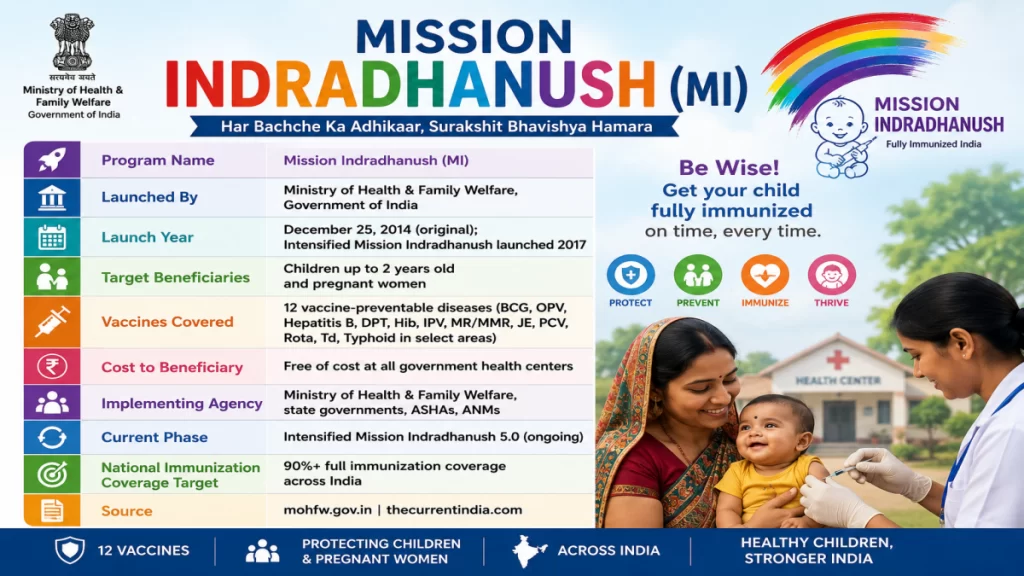
Mission Indradhanush – Quick Summary
| Program Name | Mission Indradhanush (MI) |
| Launched By | Ministry of Health & Family Welfare, Government of India |
| Launch Year | December 25, 2014 (original); Intensified Mission Indradhanush launched 2017 |
| Target Beneficiaries | Children up to 2 years old and pregnant women |
| Vaccines Covered | 12 vaccine-preventable diseases (BCG, OPV, Hepatitis B, DPT, Hib, IPV, MR/MMR, JE, PCV, Rota, Td, Typhoid in select areas) |
| Cost to Beneficiary | Free of cost at all government health centers |
| Implementing Agency | Ministry of Health & Family Welfare, state governments, ASHAs, ANMs |
| Current Phase | Intensified Mission Indradhanush 5.0 (ongoing) |
| National Immunization Coverage Target | 90%+ full immunization coverage across India |
| Source | mohfw.gov.in | thecurrentindia.com |
Mission Indradhanush is the Government of India’s flagship immunization program that provides free vaccines to children up to 2 years of age and pregnant women across the country. Launched on December 25, 2014, it targets children who have missed routine vaccines or remain partially vaccinated, covering 12 deadly but preventable diseases.
The program is implemented by the Ministry of Health and Family Welfare and operates through government health centers, Anganwadi’s, and community outreach camps run by ASHAs and ANMs.
This article explains everything you need to know: what vaccines are covered, the full immunization schedule, eligibility criteria, how to register your child, how to find the nearest vaccination center, and how it compares with private healthcare options.
What Is Mission Indradhanush?
India had a serious problem. Millions of children were not getting their routine vaccines. The National Family Health Survey (NFHS) data before 2014 showed that only about 62% of children in India received full immunization. That meant roughly 38 children out of every 100 were walking into childhood without protection against diseases like polio, tuberculosis, measles, and hepatitis B.
Mission Indradhanush was the government’s answer to that problem. The name itself comes from the seven colors of a rainbow, representing the seven diseases the program originally targeted. Over the years, it has expanded to cover 12 diseases.
The program works by identifying children and pregnant women who are left out of the Universal Immunization Programme (UIP) and reaching them through special monthly immunization drives. It targets children between birth and 2 years of age, including dropouts who have had some vaccines but not completed the full schedule.
The Mission Indradhanush Vaccination Schedule
The following table gives you the complete Mission Indradhanush vaccination schedule, organized by the child’s age. This same schedule applies under the Universal Immunization Programme (UIP) that Mission Indradhanush strengthens and extends.
| Age | Vaccines Given | Disease Protected Against |
|---|---|---|
| At Birth | BCG, OPV-0, Hepatitis B (Birth Dose) | Tuberculosis, Polio, Hepatitis B |
| 6 Weeks | OPV-1, Pentavalent-1 (DPT+Hep B+Hib), IPV-1, Rotavirus-1, PCV-1 | Polio, Diphtheria, Tetanus, Pertussis, Hib, Hepatitis B, Rotavirus diarrhea, Pneumonia |
| 10 Weeks | OPV-2, Pentavalent-2, Rotavirus-2, PCV-2 | Same as above (second dose protection) |
| 14 Weeks | OPV-3, Pentavalent-3, IPV-2, Rotavirus-3, PCV-3 | Complete primary series protection |
| 9 Months | MR Vaccine, OPV Booster, Vitamin A (1st dose) | Measles, Rubella, Polio |
| 9-12 Months (select areas) | JE Vaccine (Dose 1) | Japanese Encephalitis |
| 12 Months | PCV Booster | Pneumonia |
| 16-24 Months | DPT Booster, OPV Booster, MR Second Dose, Vitamin A (2nd dose), JE Dose 2 (select areas) | Diphtheria, Tetanus, Pertussis, Polio, Measles, Rubella, Japanese Encephalitis |
| 5-6 Years | DPT Booster 2 | Diphtheria, Tetanus, Pertussis |
| Pregnant Women (Early Pregnancy) | Td-1 (Tetanus-Diphtheria) | Tetanus, Diphtheria in mother and newborn |
| Pregnant Women (4 weeks after Td-1) | Td-2 | Complete maternal protection |
| Pregnant Women (If vaccinated in past 3 yrs) | Td Booster | Booster protection |
Note: JE (Japanese Encephalitis) vaccine is administered only in districts where JE is endemic. Typhoid Conjugate Vaccine is administered in select states as part of a phased rollout. All vaccines are free at government centers.
What Diseases Does Mission Indradhanush Cover?
Mission Indradhanush protects children from 12 vaccine-preventable diseases. Each of these diseases can cause severe complications or death, especially in children under 5 years. Here is the complete disease coverage list with the corresponding vaccines:
| Disease | Vaccine Under MI | Age of Administration | Severity if Untreated |
|---|---|---|---|
| Tuberculosis (TB) | BCG | At birth | Severe meningitis, death in infants |
| Polio | OPV + IPV | Birth, 6, 10, 14 weeks + boosters | Permanent paralysis |
| Diphtheria | Pentavalent / DPT | 6, 10, 14 weeks + boosters | Airway obstruction, heart failure |
| Pertussis (Whooping Cough) | Pentavalent / DPT | 6, 10, 14 weeks + boosters | Severe respiratory distress in infants |
| Tetanus | Pentavalent / DPT / Td | 6, 10, 14 weeks; pregnant women | Muscle spasms, death |
| Hepatitis B | Pentavalent + Birth dose | Birth + 6, 10, 14 weeks | Liver cirrhosis, liver cancer |
| Haemophilus influenzae b (Hib) | Pentavalent | 6, 10, 14 weeks | Meningitis, pneumonia |
| Measles & Rubella | MR / MMR Vaccine | 9 months + 16-24 months | Blindness, brain damage, birth defects |
| Japanese Encephalitis | JE Vaccine | 9 months + booster (select areas) | Brain swelling, death, disability |
| Rotavirus Diarrhea | Rotavirus Vaccine | 6, 10, 14 weeks | Severe dehydration, infant death |
| Pneumococcal Disease | PCV | 6, 10, 14 weeks + booster | Pneumonia, meningitis |
| Typhoid (select states) | Typhoid Conjugate Vaccine | 9-12 months (select districts) | Systemic infection, organ failure |
These 12 diseases account for a significant share of under-5 child mortality in India. Preventing them through vaccination is the most cost-effective public health intervention available.
Who Is Eligible for Free Vaccination Under Mission Indradhanush?
Eligibility for Children
Any child between birth and 2 years of age who lives in India is eligible for free vaccination under Mission Indradhanush. There are no income, caste, or religion restrictions. The program specifically prioritizes:
- Children who have never received any vaccine (zero-dose children)
- Children who started but did not complete their vaccination schedule (partial immunization)
- Children in hard-to-reach areas like remote villages, urban slums, migratory settlements, brick kilns, construction sites, and forest zones
- Children from nomadic families who may have missed fixed-schedule sessions
Eligibility for Pregnant Women
All pregnant women in India are eligible for free Tetanus-Diphtheria (Td) vaccines under Mission Indradhanush, regardless of trimester or location. This maternal vaccination protects both the mother and the newborn from neonatal tetanus, which is a leading cause of newborn deaths in rural India.
Phases of Mission Indradhanush: How the Program Has Evolved
The program has gone through multiple phases, each building on the previous one. Here is a data-driven overview of the key phases:
| Phase / Edition | Year Launched | Key Feature | Coverage Focus |
|---|---|---|---|
| Mission Indradhanush 1.0 | December 2014 | First nationwide push for routine immunization gaps | 201 high-priority districts |
| Mission Indradhanush 2.0 to 4.0 | 2015 to 2016 | Phased district expansion, catching up missed children | Expanded to 400+ districts |
| Intensified Mission Indradhanush (IMI) 1.0 | October 2017 | Accelerated pace; monthly drives, more ASHAs mobilized | Hardcore and Northeast states |
| IMI 2.0 | December 2019 | Focus on pregnant women added formally, more vaccines | 272 districts, 652 blocks |
| IMI 3.0 | February 2021 | Post-COVID catch-up immunization | 250 districts with high coverage gaps |
| IMI 4.0 | February 2022 | Intensified outreach to urban slums and remote tribal areas | 33 states and UTs |
| IMI 5.0 | 2023 onwards | Highest push to achieve 90%+ full immunization nationally | Pan-India with special focus on low-coverage pockets |
Data source: Ministry of Health and Family Welfare (mohfw.gov.in), NFHS-4 and NFHS-5 survey data.
State-Wise Immunization Coverage: Before and After Mission Indradhanush
One of the clearest ways to understand Mission Indradhanush’s impact is to look at how fully immunized child (FIC) percentages have changed at the state level. NFHS-4 (2015-16) and NFHS-5 (2019-21) data, combined with government reporting, shows substantial gains.
| State / UT | FIC % (Pre-MI, approx.) | FIC % (Post-IMI 4.0, approx.) | Notable Challenge |
|---|---|---|---|
| Uttar Pradesh | ~51% | ~76% | Largest unvaccinated child population in India |
| Bihar | ~55% | ~78% | Low female literacy affecting vaccination uptake |
| Rajasthan | ~54% | ~79% | High nomadic population, hard-to-reach areas |
| Madhya Pradesh | ~53% | ~77% | Large tribal population with limited access |
| Jharkhand | ~50% | ~74% | Dense forest zones with poor ASHA coverage |
| Assam | ~57% | ~80% | Flood-prone areas disrupting regular sessions |
| Odisha | ~62% | ~84% | Good improvement through community mobilization |
| Gujarat | ~71% | ~89% | Urban-rural divide persists |
| Tamil Nadu | ~86% | ~94% | High literacy drives better vaccination compliance |
| Kerala | ~91% | ~97% | Among India’s best-performing states |
| National Average | ~62% | ~90% (target) | Urban slums and migrant populations remain gaps |
Sources: NFHS-4, NFHS-5, Ministry of Health and Family Welfare annual reports. FIC = Full Immunization Coverage. Figures are approximate and reflect available survey data.
These numbers make Mission Indradhanush data highly citable for researchers, journalists, and policy organizations. The program represents one of the largest improvements in routine immunization coverage in Indian public health history.
How to Register a Child for Mission Indradhanush
Registering a child for Mission Indradhanush is simple. You do not need to go through complicated paperwork or pay any fee. Here are the steps:
- Contact your nearest ASHA (Accredited Social Health Activist) worker. She will track unvaccinated children in your locality and inform you about the next vaccination drive.
- Visit your nearest Primary Health Centre (PHC), Sub-Centre, Community Health Centre (CHC), or Anganwadi center during routine immunization days or special Mission Indradhanush drive days.
- Carry your child’s birth certificate or any proof of age. A mother-child protection card issued by the hospital at birth also works.
- The health worker will create or update a vaccination card for your child listing all vaccines received and due.
- Use the U-Win portal (uwin.mohfw.gov.in) or the government’s online immunization platform to register digitally in districts where this service is available. The portal lets you track your child’s vaccination history and upcoming due dates.
Where to Find the Nearest Mission Indradhanush Immunization Center
There are several ways to locate the nearest vaccination center for your child:
1. Contact Your ASHA Worker
Every village and urban ward has an assigned ASHA worker. She is the first point of contact for all immunization-related queries. ASHAs conduct door-to-door surveys, inform parents about upcoming sessions, and accompany families to vaccination centers.
2. Visit Your PHC or Sub-Centre
Primary Health Centres (PHCs) and Sub-Centres hold fixed immunization sessions, typically on Wednesdays and Fridays across India. Your district’s health department schedule may vary. The session is usually free, walk-in, and requires no prior appointment.
3. Use the U-Win Digital Portal
The U-Win portal (uwin.mohfw.gov.in) is the government’s digital immunization tracking platform. You can use it to locate vaccination centers, register your child, and get due-date alerts. The platform is being rolled out nationally in phases.
4. Call the National Health Helpline
You can call 104, the National Health Helpline, to get information about the nearest vaccination center and upcoming drive schedules in your area.
5. Anganwadi Centers
Anganwadi centers under the Integrated Child Development Services (ICDS) scheme also conduct vaccination sessions in coordination with Mission Indradhanush drives. These centers are present in nearly every village and urban slum.
How to Book a Mission Indradhanush Vaccination Appointment Online
Online appointment booking for Mission Indradhanush is available through the U-Win portal. Here is how to use it:
- Visit uwin.mohfw.gov.in on your mobile or computer.
- Register using your mobile number and OTP verification.
- Add your child’s details: name, date of birth, and district.
- The portal will show your child’s vaccination history (if already partially vaccinated) and the next due vaccines.
- Select an available session at a nearby center and confirm the booking.
- You will receive an SMS reminder before the session date.
Note: U-Win is fully functional in several states and districts. In areas where it is not yet live, the walk-in system at PHCs and Anganwadis remains the primary mode. Check with your ASHA worker about U-Win availability in your district.
Mission Indradhanush vs. Private Vaccination: A Comparison
Many parents ask whether Mission Indradhanush covers everything or if they need to go to a private hospital. The comparison below answers that question clearly:
| Feature | Mission Indradhanush (Govt.) | Private Healthcare Providers |
|---|---|---|
| Cost | Completely free | Rs. 2,000 to Rs. 15,000+ for full schedule |
| Vaccines Included | 12 government-approved vaccines | 12 to 16 vaccines including optional ones (Varicella, Meningococcal, etc.) |
| Access Points | PHCs, sub-centers, Anganwadis, outreach camps | Hospitals, clinics, pediatric chains |
| Appointment System | Walk-in at most centers; U-Win portal for registration | Online / in-person booking; dedicated pediatric sessions |
| Record Keeping | Vaccination card (manual); transitioning to U-Win digital | Detailed digital records with reminders |
| Optional Vaccines | Not covered | Varicella, Meningococcal, HPV available at extra cost |
| Convenience | Fixed schedule; may need multiple visits | Flexible timings; single window for full schedule |
| ASHA / ANM Support | Yes, active outreach | Not applicable |
| Best For | All Indian children, especially those without insurance | Families wanting optional vaccines or digital records |
The government program covers all essential vaccines recommended by the National Technical Advisory Group on Immunization (NTAGI). Private providers offer additional optional vaccines, such as the Varicella (chickenpox) vaccine and Meningococcal vaccine, which are not yet part of the national program. These are safe and recommended by pediatricians but involve additional cost.
Key Stakeholders Who Implement Mission Indradhanush
Mission Indradhanush works because of a network of health workers at the ground level. Here is who does what:
- ASHA Workers: Identify unvaccinated children, mobilize families, accompany mothers to centers
- ANMs (Auxiliary Nurse Midwives): Administer vaccines, maintain records, conduct outreach sessions
- Anganwadi Workers: Coordinate with ASHAs, maintain child records, host sessions at centers
- District Health Officers: Plan drives, allocate resources, monitor coverage
- State Health Departments: Fund operations, track data, coordinate with the central Ministry
- Ministry of Health and Family Welfare: Policy, national targets, U-Win portal, global reporting to WHO and UNICEF
Mission Indradhanush and India’s Immunization Data: Key Statistics
Here is a data summary that makes this article linkable and citable for researchers and publishers:
- India’s full immunization coverage rose from 62% (NFHS-4, 2015-16) to 76.4% (NFHS-5, 2019-21) after Mission Indradhanush interventions.
- Under Intensified Mission Indradhanush (IMI) 4.0, over 3.86 crore children and pregnant women were vaccinated between February and April 2022.
- India is targeting 90% full immunization coverage under IMI 5.0.
- India has maintained polio-free status since 2014, partly attributed to Mission Indradhanush’s strengthening of routine immunization.
- An estimated 1.38 crore children in India were zero-dose children before the intensified drives. MI specifically targets this population.
- UNICEF and WHO rank Mission Indradhanush as one of the largest immunization catch-up campaigns in the world by scale and reach.
What Are the Best Indian Mutual Fund Schemes for NRIs?
If you are an NRI (Non-Resident Indian) looking to invest in Indian mutual funds, you have several strong options across different risk profiles. NRIs can invest in Indian mutual funds through NRE or NRO accounts, subject to FEMA regulations. Note that US and Canada-based NRIs face restrictions with some fund houses due to FATCA compliance requirements.
Here is a comparison table to help NRIs choose the right category and schemes:
| Fund Category | Example Schemes | Ideal For NRI Profile | Key Note |
|---|---|---|---|
| Large Cap Equity | SBI Bluechip Fund, ICICI Pru Bluechip | Conservative NRI, long-term wealth building | Stable; lower volatility than mid/small cap |
| Flexi Cap Equity | Parag Parikh Flexi Cap, HDFC Flexi Cap | NRIs wanting diversified equity exposure | Invests across market caps; balanced approach |
| Mid & Small Cap | Nippon India Small Cap, Axis Midcap Fund | High-risk appetite NRIs with 7+ year horizon | Higher returns potential; higher risk |
| Index Funds / ETFs | UTI Nifty 50 Index Fund, HDFC Sensex ETF | Passive investors wanting market-linked returns | Low expense ratio; no fund manager risk |
| Balanced / Hybrid | ICICI Pru Balanced Advantage, Kotak Equity Hybrid | NRIs wanting equity + debt mix in one fund | Lower volatility; good for moderate risk profile |
| Liquid / Debt Funds | HDFC Liquid Fund, Aditya Birla Sun Life Savings | NRIs parking short-term surplus funds in INR | Low risk; suitable for 3 months to 1 year horizon |
| ELSS (Tax Saving) | Mirae Asset ELSS, DSP Tax Saver Fund | NRIs with India-sourced income seeking 80C benefit | 3-year lock-in; tax deduction under Section 80C for resident NRIs |
| International / Global | Franklin India Feeder – US Opportunities, Motilal Oswal Nasdaq 100 | NRIs wanting USD-denominated global equity exposure | Currency risk works in NRI’s favor during INR depreciation |
Note: This comparison is for general information only and is not investment advice. Consult a SEBI-registered financial advisor before investing. NRIs from the US and Canada should confirm fund house eligibility before investing.
Frequently Asked Questions About Mission Indradhanush
What is the Mission Indradhanush vaccination schedule?
The Mission Indradhanush vaccination schedule follows India’s Universal Immunization Programme (UIP). It begins at birth with BCG, OPV-0, and Hepatitis B, followed by doses at 6, 10, and 14 weeks (Pentavalent, OPV, IPV, Rotavirus, PCV), then at 9 months (MR vaccine and OPV booster), and booster doses between 16 and 24 months. Pregnant women receive Tetanus-Diphtheria (Td) vaccines in two doses during pregnancy. The full schedule protects against 12 diseases.
What are the eligibility criteria for free child vaccinations under Mission Indradhanush?
All children between birth and 2 years of age living in India are eligible, regardless of income, caste, religion, or location. The program especially prioritizes zero-dose children (never vaccinated), partially vaccinated children, and those in hard-to-reach areas. Pregnant women are also eligible for free Td vaccines. No income proof or documentation is required beyond basic identity.
Where can I find Mission Indradhanush immunization centers near me?
You can find a nearby vaccination center through your local ASHA worker, by visiting the nearest PHC or Anganwadi center, using the U-Win portal at uwin.mohfw.gov.in, or calling the National Health Helpline at 104. Government immunization sessions are typically held on Wednesdays and Fridays at PHCs, though drives under Mission Indradhanush run on specific dates announced by the district health office.
How can I locate the nearest government vaccination center for my infant?
The easiest way is to contact your ASHA worker, who is assigned to your village or urban ward. You can also visit your nearest Sub-Centre, PHC, Community Health Centre, or Anganwadi. The U-Win portal allows online center search and appointment booking in many districts. Calling 104 also gives you health facility information based on your location.
How do I book a Mission Indradhanush vaccination appointment online?
Visit the U-Win portal at uwin.mohfw.gov.in, register with your mobile number via OTP, add your child’s details, and select an available session near you. U-Win is available in several states. In districts where the portal is not yet active, you can walk in to the nearest PHC or Anganwadi on immunization session days without a prior appointment.
What specific diseases are covered by Mission Indradhanush?
Mission Indradhanush currently covers 12 vaccine-preventable diseases: Tuberculosis (BCG), Polio (OPV + IPV), Diphtheria, Tetanus, Pertussis (whooping cough), Hepatitis B, Haemophilus influenzae b (Hib), Measles, Rubella, Japanese Encephalitis (in endemic districts), Rotavirus diarrhea, and Pneumococcal disease. Typhoid is being added in select districts through a phased rollout.
Which healthcare providers offer Mission Indradhanush vaccines?
Mission Indradhanush vaccines are administered exclusively through government health facilities: Primary Health Centres (PHCs), Sub-Centres, Community Health Centres (CHCs), Anganwadi centers, and outreach camps run by ASHAs and ANMs. Private hospitals do not administer government-program vaccines, though they offer similar vaccines as part of paid packages.
Are there private healthcare providers offering vaccination packages similar to Mission Indradhanush?
Yes. Private hospitals and pediatric clinics offer comprehensive childhood vaccination packages that cover the same 12 diseases as Mission Indradhanush, plus additional optional vaccines like Varicella (chickenpox), Meningococcal, and HPV vaccines. These packages typically cost Rs. 2,000 to Rs. 15,000 or more depending on the vaccines included. They offer digital records and appointment flexibility, but the essential vaccines are identical to what is available free under Mission Indradhanush.
What steps are involved in registering a child for government-sponsored immunization?
Registration involves five steps: (1) Contact your ASHA worker or visit the nearest PHC or Anganwadi. (2) Carry proof of your child’s birth date, such as a birth certificate or hospital discharge card. (3) The health worker creates a vaccination card for your child. (4) Vaccines are administered free of charge on the spot or on the next available session date. (5) For digital tracking, register on the U-Win portal at uwin.mohfw.gov.in to receive reminders for upcoming doses.
The Bottom Line
Mission Indradhanush is one of the most important public health programs in India. It gives every child and every pregnant woman in the country access to life-saving vaccines at no cost. Whether you live in a village in Bihar, an urban slum in Mumbai, or a remote tribal area in Jharkhand, the vaccines are available and they are free.
If your child has missed any doses, contact your ASHA worker today. Do not wait for the next drive. Walk into the nearest PHC and ask. The vaccines are there. The program is running. Your child deserves full protection.
Sources: Ministry of Health and Family Welfare (mohfw.gov.in), NFHS-4 and NFHS-5 data, WHO and UNICEF immunization country reports, U-Win portal.
Interesting Reads
- UDAN Scheme – How India’s Regional Air Connectivity Plan Works for Tier-2 & Tier-3 Cities
- PM Kaushal Vikas Yojana (PMKVY)- Free Skill Training, Benefits, and How to Apply
- PM Kisan Samman Nidhi – The Complete Guide
- Central Government Health Scheme Card (CGHS) – Eligibility, How to Download and Apply
- Kisan Credit Card Scheme – Are You Eligible?
- List Of Central and State Government Schemes for Women’s Self-Help Groups in India
- Top 8 Government Scheme for Startups in India – Complete Guide
- Are There Government Schemes Providing Free Digital Literacy Courses in India?
- EV Subsidy in India – Which Government Schemes Offer Subsidies for Electric Vehicle Buyers in India?
- Top Government Subsidy for Solar Panels in India – Complete Guide for Homeowners
- What Are Government-Backed Home Loans for First-Time Buyers in India Complete Guide
- PM KUSUM Scheme: Solar Pumps, Eligibility, Subsidy
- PM Jeevan Jyoti Bima Yojana (PMJJBY): ₹436/Year Life Insurance for All Indians
- PM Fasal Bima Yojana (PMFBY) – Crop Insurance Explained
