Indian Citizenship Proof Documents: Full List, Verification Portals and How to Apply
If you’ve tried to prove you’re an Indian citizen using your Aadhaar card, you already know the confusion. The Election Commission told the Supreme Court that Aadhaar is not proof of citizenship (Supreme Court of India / Election Commission, 2025), and most people carrying it as their default ID have never heard that.
This guide lists exactly which Indian citizenship proof documents the government recognizes, which everyday IDs don’t count, where to verify them online, and how to apply for a citizenship certificate without running between offices. No legal jargon, just what works.
Key Takeaways
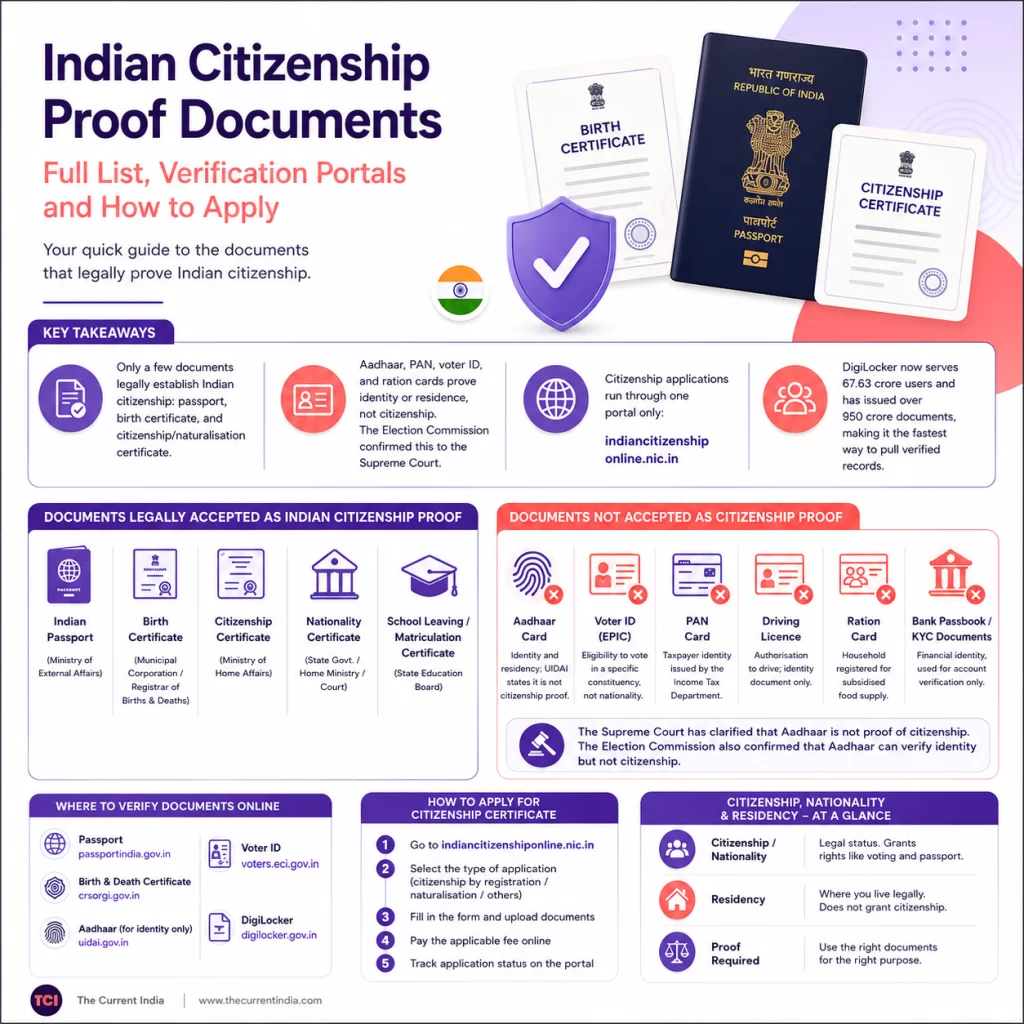
●	Only a handful of documents legally establish Indian nationality: passport, birth certificate, and citizenship/naturalisation certificate.
●	Aadhaar, PAN, voter ID, and ration cards prove identity or residence, not citizenship. The Election Commission confirmed this to the Supreme Court itself.
●	Citizenship applications run through one portal only: indiancitizenshiponline.nic.in.
●	DigiLocker now serves 67.63 crore users and has issued over 950 crore documents, making it the fastest way to pull a verified birth certificate or passport record.
Indian Citizenship Proof Documents: Citizenship, Nationality and Residency: What’s the Difference?
Citizenship is a legal status. People confuse it with two other words, and sorting that out first saves time before you go looking for proof of any of them.
- Citizenship is your legal standing within a country. It comes with defined rights and duties: voting, holding a passport, contesting elections, and accessing government services. India governs it through the Citizenship Act, 1955, and it can be acquired by birth, descent, registration, naturalisation, or incorporation of territory.
- Nationality, in India’s legal context, means the same thing as citizenship. India doesn’t separate the two concepts the way some countries do. Internationally, nationality can point to ethnic or cultural belonging rather than legal status, and that’s probably where the confusion started for Indian readers too.
- Residency is a different question. It’s about where you currently live and under what legal permission, not who you are. A foreign national can live in India for years without becoming a citizen. An Indian citizen living abroad can count as a “non-resident” for tax purposes while remaining a citizen the whole time. Residency never grants or removes citizenship.
| Aspect | Citizenship | Nationality | Residency |
| Meaning | Legal status granting rights and duties within a state | Used interchangeably with citizenship in India | Where a person currently and legally lives |
| Governing law in India | Citizenship Act, 1955 | No separate law; treated as identical to citizenship | Income Tax Act, FEMA, and visa/immigration rules |
| Grants voting rights | Yes | Yes, same status in India | No |
| Grants passport eligibility | Yes | Yes, same status in India | No |
| Can change without changing the other two | No; citizenship change is a legal process | No, since it mirrors citizenship in India | Yes; residency can change every year based on stay |
| Proof required | Passport, birth certificate, citizenship certificate | Same documents as citizenship | Utility bills, rent agreement, visa/residence permit, tax residency certificate |
Treat “proof of citizenship” and “proof of nationality” as the same requirement in India for all practical purposes. Residency proof is a separate document set. Having one never substitutes for the other.
Which Documents Are Legally Accepted as Indian Nationality Proof?
India doesn’t issue one universal citizenship card. Instead, the Citizenship Act, 1955 and its related rules recognise a set of documents that, alone or together, establish nationality.
| Document | Issuing Authority | Why It Counts |
| Indian Passport | Ministry of External Affairs (Passport Seva) | Issued only after citizenship is verified; treated as the strongest evidentiary proof |
| Birth Certificate (before/after 1987, with parent citizenship proof) | Municipal Corporation / Registrar of Births & Deaths | Corroborates citizenship by birth under Section 3 of the Citizenship Act |
| Citizenship Certificate | Ministry of Home Affairs (registration/naturalisation) | Direct legal proof for citizens by registration or naturalisation |
| Nationality Certificate | State Government / Home Ministry / Court | Issued in specific cases where no other document is available |
| Domicile Certificate | State Revenue Department | Supports residency claims, used alongside other proofs |
| School Leaving / Matriculation Certificate showing nationality | State Education Board | Accepted as supporting evidence in several administrative processes |
Most Indians never formally need to prove citizenship in daily life. The need shows up during passport applications, government job verification, election-related scrutiny, or property and legal disputes involving foreign nationals.
Which Documents Are NOT Accepted as Citizenship Proof?
This is where most people go wrong. These IDs are common, but none of them legally establish nationality. They establish identity or residence only.
| Document | What It Proves |
| Aadhaar Card | Identity and residency; UIDAI itself states it is not citizenship proof |
| Voter ID (EPIC) | Eligibility to vote in a specific constituency, not nationality |
| PAN Card | Taxpayer identity issued by the Income Tax Department |
| Driving Licence | Authorisation to drive; identity document only |
| Ration Card | Household registered for subsidised food supply |
| Bank Passbook / KYC documents | Financial identity, used for account verification only |
This is on record with the country’s highest court now. During the Bihar Special Intensive Revision case, the Supreme Court clarified that Aadhaar is not proof of citizenship, and the Election Commission confirmed to the court that Aadhaar can verify identity but not citizenship for the state’s revised voter list (Election Commission of India, September 2025).
The commission grounded this in a UIDAI office memorandum from August 2023 stating Aadhaar was never evidence of citizenship, residence, or birthdate. If a document can legally be issued to a long-term resident who isn’t a citizen, it can’t double as nationality proof. That’s the test the government applies, and it’s a useful rule of thumb for readers too.
Can You Use Your Passport as Proof of Indian Citizenship?
Yes, in practice, with a legal footnote.
A passport is issued under the Passports Act, 1967, by the Ministry of External Affairs, while citizenship itself sits under the Ministry of Home Affairs and the Citizenship Act, 1955. The passport office must verify nationality before issuing the document, so most institutions, banks, and even foreign embassies treat it as strong proof of citizenship.
Officials have clarified that passports are technically travel documents first. In rare cases, passports have been issued to non-citizens under specific government exceptions, so it isn’t an absolute legal guarantee. For nearly all everyday and legal purposes, your passport remains the single most reliable citizenship proof document you’re likely to carry.
Where Can You Verify Citizenship Documents Online?
Several official portals let you verify citizenship-related documents digitally. Bookmark these instead of visiting a government office in person.
| Portal | What You Can Verify | Website |
| Indian Citizenship Online (MHA) | Citizenship application status, registration/naturalisation certificates | indiancitizenshiponline.nic.in |
| Passport Seva / mPassport | Passport authenticity, application and dispatch status | passportindia.gov.in |
| DigiLocker | Digitally verified birth certificates, passports, and academic records linked to government databases | digilocker.gov.in |
| National Voters Service Portal (NVSP) | Voter ID details (identity, not citizenship) | voters.eci.gov.in |
| Civil Registration System (CRS) | Birth and death certificate verification, state-wise | crsorgi.gov.in |
DigiLocker has become the default verification layer for most of these documents. As of March 2026, DigiLocker had 67.63 crore users and had issued over 950 crore documents through the platform (Government of India, Digital Public Infrastructure release, March 2026). That scale is why it’s usually the quickest route to a verified record. More on that below.
Each state also runs its own e-District portal for birth certificate downloads and verification, since civil registration is a state subject. Search “e-District [your state name]” to find the correct one for you.
Where Do You Apply for an Official Citizenship Certificate?
For a formal citizenship or naturalisation certificate, the only legitimate starting point is indiancitizenshiponline.nic.in, run by the Ministry of Home Affairs. The process, step by step:
- Register on the portal and select the relevant section: registration (Section 5) or naturalisation (Section 6) of the Citizenship Act.
- Fill the online form and upload supporting documents such as your birth certificate, residence proof, and existing identity documents.
- Pay the prescribed fee online.
- Submit a printout at the office of your District Collector, District Magistrate, or Deputy Commissioner. If you live abroad, submit it to the Indian Consulate instead.
- Track your application status directly on the portal. Updates also arrive by SMS and email.
- On approval, you receive a digital certificate of registration or naturalisation. A physical, ink-signed copy is issued only if you opted for it during application.
For a birth certificate, the most common supporting proof, apply through your municipal corporation’s website or your state’s e-District portal, not the MHA site. Mixing up the two is a common, avoidable delay.
Indian citizenship and naturalisation certificates can only be applied for online through indiancitizenshiponline.nic.in, the Ministry of Home Affairs’ sole portal for Sections 5 and 6 of the Citizenship Act, 1955. No state government or private agency is authorised to process these applications.
How Do You Verify If a Citizenship Document Is Genuine?
Fake or tampered documents are a real problem, especially with birth certificates and old-format nationality papers. You can check authenticity without hiring an agent.
- Passports: Use the status tracker on passportindia.gov.in, or call the 24×7 Passport Seva helpline with your file number.
- Birth certificates: Cross-check the registration number on your state’s Civil Registration System (CRS) or e-District portal. Every valid certificate has a traceable registration number.
- Citizenship certificates: Verify application and certificate status directly on indiancitizenshiponline.nic.in using your acknowledgement number.
- DigiLocker-issued copies: Any document pulled through DigiLocker is auto-verified against the source government database, so it can’t be forged.
- Court-issued nationality certificates: Verification has to go through the issuing court registry directly. There’s no central online database for these yet.
Document fraud tracks digital adoption closely. As more processes move online, verification tools have to keep pace, and DigiLocker’s consent-logged, database-linked design responds directly to that pressure.
The Ministry of Home Affairs, Passport Seva, and state Civil Registration Systems each maintain independent online verification tools tied to unique registration or acknowledgement numbers. DigiLocker-issued copies are auto-checked against the source government database at the point of sharing, making tampering effectively self-evident.
What’s the Fastest Way to Get Citizenship Proof Documents Digitally?
If you need proof quickly, for a job, a visa, or an admission deadline, this is the fastest realistic path.
| Step | Action | Typical Time |
| 1 | Link Aadhaar and check if your birth certificate is already digitised on DigiLocker | Instant, if already uploaded by your municipality |
| 2 | If not available, request a digital birth certificate copy from your state’s e-District/CRS portal | 1–7 working days |
| 3 | If you hold a passport, download the e-passport or verify status on the mPassport Seva app | Instant to 2 days |
| 4 | For a fresh citizenship certificate, apply on indiancitizenshiponline.nic.in and track status online | Weeks to months, depending on scrutiny |
For most practical situations, school admission, bank KYC escalation, or government scheme eligibility, a DigiLocker-verified birth certificate or passport copy resolves the issue within days. Save the fresh citizenship certificate application, the slowest route, for when no other proof exists.
For most Indians, a DigiLocker-verified birth certificate or passport record resolves identity and citizenship checks within days, since DigiLocker had issued over 950 crore documents to 67.63 crore users as of March 2026. A fresh citizenship certificate application, by contrast, can take weeks to months.
Is There Only One Official Portal for Citizenship Services?
Yes. There is exactly one central portal for citizenship services in India: indiancitizenshiponline.nic.in, maintained by the Ministry of Home Affairs. It handles applications under Sections 5 and 6 of the Citizenship Act, 1955, status tracking, and issuance of digital certificates.
Treat any other website or “agent” promising a faster citizenship certificate with caution. Citizenship, unlike a duplicate PAN card, isn’t something private portals are authorized to process. If a service asks for payment outside the official portal or the District Collector’s office, walk away.
The Ministry of Home Affairs operates indiancitizenshiponline.nic.in as the single central portal for Indian citizenship services, covering registration (Section 5) and naturalization (Section 6) applications under the Citizenship Act, 1955. Any other site charging for “faster” certificates is unauthorized.
Frequently Asked Questions On Indian Citizenship Proof Documents
Is Aadhaar accepted as proof of Indian citizenship?
No. UIDAI stated in an August 2023 office memo that Aadhaar is not evidence of citizenship, place of residence, or birthdate, and the Election Commission repeated this to the Supreme Court in 2025. Aadhaar only proves identity.
Can a passport alone prove Indian citizenship?
In practice, yes. Passports are issued only after the Ministry of External Affairs verifies nationality, so most institutions accept them as strong proof. Legally, a passport is a travel document first, and rare exceptions exist where non-citizens have been issued one.
Where do I apply for a citizenship certificate in India?
Only through indiancitizenshiponline.nic.in, the Ministry of Home Affairs portal, under Section 5 (registration) or Section 6 (naturalization) of the Citizenship Act, 1955. No other website is authorized to process these applications.
How do I check if my birth certificate is genuine?
Cross-check its registration number on your state’s Civil Registration System (CRS) or e-District portal. Every valid certificate carries a traceable registration number tied to the issuing municipal office.
Is DigiLocker a reliable way to prove citizenship documents?
Yes, for verification purposes. As of March 2026, DigiLocker had 67.63 crore users and had issued over 950 crore documents, and every document pulled through it is auto-verified against the source government database, so it’s hard to fake.
Bottom line: keep your passport, birth certificate, and any citizenship certificate safe. These are your real proofs of nationality. Everything else in your wallet proves who you are, not where you belong.
This explainer was compiled by The Current India’s editorial desk from Ministry of Home Affairs, Passport Seva, and Election Commission sources, and will be updated as government rules evolve.
Interesting Reads
