PM KUSUM — Solar Panels for Farmers: Eligibility and How to Apply
| PM KUSUM Scheme — Quick Summary | |
| Full Name | Pradhan Mantri Kisan Urja Suraksha evam Utthaan Mahabhiyan |
| Also Known As | PM KUSUM Yojana / PM KUSUM Scheme |
| Launched By | Ministry of New and Renewable Energy (MNRE), March 2019 |
| Scheme Valid Until | March 31, 2026 |
| Total Solar Target | 34,800 MW |
| Central Budget | ₹34,422 crore |
| Budget 2025-26 | ₹2,600 crore allocated |
| Central Subsidy | 30% (50% for hilly/NE states) |
| State Subsidy | 30% minimum |
| Farmer’s Share | As low as 10% (with bank loan for 30%) |
| Official Portal | pmkusum.mnre.gov.in |
| Reported By | The Current India |
Quick Summary
PM KUSUM (Pradhan Mantri Kisan Urja Suraksha evam Utthaan Mahabhiyan) is a central government scheme launched in March 2019 by the Ministry of New and Renewable Energy (MNRE). It helps Indian farmers install solar-powered irrigation pumps at up to 60% subsidy. The central government pays 30% and the state government pays another 30%. Farmers pay only the remaining 10% upfront (with a 30% bank loan option).
Table of Contents
What Is the PM KUSUM Scheme for Farmers?
PM KUSUM stands for Pradhan Mantri Kisan Urja Suraksha evam Utthaan Mahabhiyan. The Government of India launched the PM KUSUM scheme in March 2019 through the Ministry of New and Renewable Energy (MNRE).
It gives Indian farmers access to solar-powered irrigation pumps at a heavily subsidized price. You also hear it called PM KUSUM Yojana or the PM KUSUM Scheme — all three names refer to the same program.
The scheme has one big goal: cut the cost of irrigation. Diesel pumps cost farmers thousands of rupees in fuel every season. Erratic electricity supply makes grid pumps unreliable. The PM KUSUM scheme replaces both with sunlight — which is free.
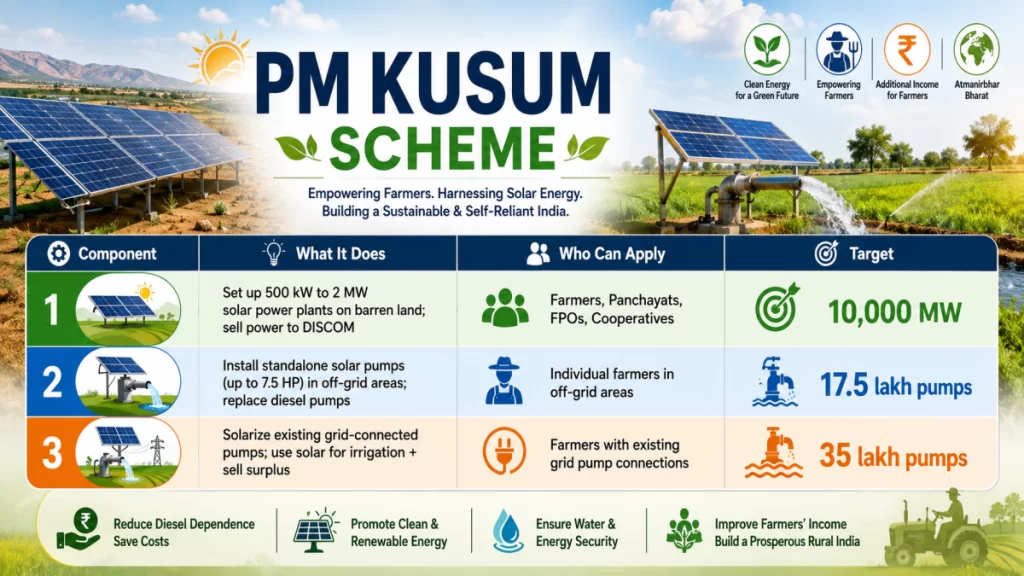
Farmers who join the scheme can do three things under it: earn money by selling solar power to the grid, irrigate fields for free using solar pumps, and solarize existing grid pumps so they run during the day without waiting for electricity.
The Three Components of PM KUSUM
| Component | What It Does | Who Can Apply | Target |
|---|---|---|---|
| 1 | Set up 500 kW to 2 MW solar power plants on barren land; sell power to DISCOM | Farmers, Panchayats, FPOs, Cooperatives | 10,000 MW |
| 2 | Install standalone solar pumps (up to 7.5 HP) in off-grid areas; replace diesel pumps | Individual farmers in off-grid areas | 17.5 lakh pumps |
| 3 | Solarize existing grid-connected pumps; use solar for irrigation + sell surplus | Farmers with existing grid pump connections | 35 lakh pumps |
PM KUSUM Scheme — Key Data and Statistics
This data comes directly from MNRE reports, the Union Budget 2025-26, and official government announcements. TheCurrentIndia.com compiles it here for easy reference.
| Metric | Data Point |
|---|---|
| Scheme launched | March 8, 2019 |
| Extended until | March 31, 2026 |
| Total solar target | 34,800 MW |
| Central budget (total) | ₹34,422 crore |
| Budget 2025-26 allocation | ₹2,600 crore |
| Pumps installed (Component B, FY25) | 4.4 lakh (4.2x jump over FY24) |
| Pumps solarized (Component C, FY25) | 2.6 lakh (25x jump over FY24) |
| Total farmers benefited (as of June 2024) | 4.11 lakh+ |
| Max pump capacity (Component B) | 7.5 HP (raised to 15 HP in updates) |
| India solar water pump market (2024) | USD 112.68 million; growing to USD 221.54M by 2033 |
Record Progress in FY25: Component B installations jumped 4.2x to 4.4 lakh pumps. Component C solarizations jumped 25x to 2.6 lakh pumps — the fastest single-year growth since the scheme launched.
Who Is Eligible for the PM KUSUM Scheme?
The PM KUSUM Yojana has broad eligibility. You do not need to be a large landowner or have a high income to qualify. Here is who can apply under each component.
Eligibility for Component A (Solar Power Plant on Land)
- Individual farmers who own barren, fallow, or semi-cultivable land
- Group of farmers applying jointly
- Panchayats and Gram Sabhas
- Farmer Producer Organizations (FPOs)
- Water User Associations (WUAs)
- Cooperatives and local bodies
Eligibility for Component B (Standalone Solar Pump)
- Individual farmers who live in off-grid or low-grid areas
- Farmers currently using diesel pumps for irrigation
- Pump capacity applied for must be up to 7.5 HP (higher in some states)
- Must own or cultivate agricultural land
- Farmer Producer Organizations in eligible areas
Eligibility for Component C (Solarize an Existing Grid Pump)
- Farmers who already have a grid-connected agricultural pump
- Must hold a valid electricity connection for the pump
- The solar PV capacity allowed is up to twice the pump capacity in kW
Important: Eligibility rules vary slightly by state. Some states like Karnataka have increased their subsidy to 50%, which means farmers there contribute only 20% of the cost. Always check your state nodal agency website for the latest rules.
PM KUSUM Subsidy: How Much Do You Actually Pay?
Under the PM KUSUM scheme, the central government provides 30% Central Financial Assistance (CFA). The state government adds another minimum 30% subsidy. That gives you a combined subsidy of up to 60% of the total pump cost. The remaining 40% comes from you — but you can take a bank loan for 30%, so your actual upfront payment is only 10% of the total cost.
| Region | Central Govt | State Govt | Farmer Pays |
| General States | 30% | 30% | 40% (10% upfront*) |
| NE States, J&K, HP, Uttarakhand, A&N, Lakshadweep | 50% | 30% | 20% (10% upfront*) |
| Karnataka (enhanced) | 30% | 50% | 20% |
| Haryana (up to 7.5 HP) | 30% | 45% | 25% |
*Bank loan of up to 30% available through SBI and other participating banks. SBI has published specific PM KUSUM lending guidelines on the MNRE portal.
Cost Breakdown: What Does a Solar Pump Cost Under PM KUSUM?
Solar pump prices depend on capacity (measured in horsepower or HP) and the type (surface or submersible). The table below shows approximate costs before and after subsidy in general states.
| Pump Capacity | Total Cost (approx.) | Subsidy (60%) | Bank Loan (30%) | Farmer Pays (10%) |
|---|---|---|---|---|
| 3 HP (Surface) | ₹1.5 – 2 lakh | ₹90,000 – 1.2 lakh | ₹45,000 | ~₹15,000 |
| 5 HP (Submersible) | ₹2.5 – 3.5 lakh | ₹1.5 – 2.1 lakh | ₹75,000 | ~₹25,000 |
| 7.5 HP (Submersible) | ₹4.5 – 5 lakh | ₹2.7 – 3 lakh | ₹1.35 lakh | ~₹45,000 |
| 10–15 HP (Large Farm) | ₹6 – 9 lakh | Varies by state | Up to 30% | Varies |
Note: Prices are indicative based on MNRE benchmark costs and market data as of 2025. Actual cost depends on your state’s tender rates. The MNRE subsidy applies on the benchmark cost or tender cost, whichever is lower.
How to Apply Online for PM KUSUM Solar Pump Subsidy
You can apply through your state’s nodal agency website or through the national PM KUSUM portal at pmkusum.mnre.gov.in. The process is mostly the same across states.
Step-by-Step Application Process
- Go to pmkusum.mnre.gov.in or your state nodal agency website (see the state portal table below).
- Click on ‘Farmer Registration’ or ‘Apply Online.’
- Enter your Aadhaar number and verify with OTP.
- Fill in your personal details: name, address, land details, pump requirement.
- Select the component you want to apply under (A, B, or C).
- Upload the required documents (listed in the next section).
- Submit the form and note down your application number.
- The state nodal agency will verify your land and pump details.
- After approval, you receive a sanction letter. The subsidy gets adjusted directly in the pump cost.
- The approved vendor installs the pump at your farm. You pay only your share.
State-Wise Application Portals
| State | Application Portal / Agency |
|---|---|
| Rajasthan | rreclmis.rajasthan.gov.in (RRECL) |
| Maharashtra | mahaurja.com (MAHAURJA) |
| Uttar Pradesh | upneda.in (UPNEDA) |
| Haryana | pmkusum.hareda.gov.in (HAREDA) |
| Karnataka | resco.karnataka.gov.in (KREDL) |
| Gujarat | geda.gujarat.gov.in (GEDA) |
| All States | pmkusum.mnre.gov.in (National Portal — check state link here) |
Tip from The Current India: If you cannot apply online yourself, visit your nearest Common Service Centre (CSC) or Kisan Seva Kendra. They help farmers fill and submit PM KUSUM applications for a small fee.
Documents Required for PM KUSUM Application
Keep these documents ready before you start your application. Uploading them correctly speeds up approval.
| Document | Purpose / Details |
|---|---|
| Aadhaar Card | Identity proof of farmer |
| Land Records (Khasra / 7/12) | Proof of agricultural land ownership |
| Bank Account + Passbook | For subsidy credit via DBT |
| Electricity Bill / Connection | Required for Component C (grid-connected pump) |
| Passport-Size Photo | For application form |
| Mobile Number (Aadhaar-linked) | For OTP verification and status updates |
| Caste Certificate (if applicable) | SC/ST farmers may get priority allotment |
| PAN Card (for large projects) | Required for Component A (solar plant setup) |
Some states also ask for a soil health card, crop details, or a no-objection certificate from your gram panchayat. Check your state portal for the complete list before applying.
Top Companies Offering Solar Pumps Under PM KUSUM
The MNRE empanels vendors who meet its quality and testing standards. You must buy from MNRE-approved or state-approved vendors to get the subsidy. Here are the leading companies active under the PM KUSUM scheme.
| Company | Products / Strength | States Active |
|---|---|---|
| Tata Power Solar | 3–7.5 HP AC/DC pumps; empaneled MNRE vendor | Pan-India |
| Shakti Pumps | Solar submersible & surface pumps; 3,174 pumps in Haryana alone | Haryana, MP, Rajasthan |
| Waaree Energies | ALMM-listed solar modules; wide pump range | Gujarat, Maharashtra |
| Vikram Solar | High-efficiency PERC modules for pumps | Bengal, South India |
| Adani Solar | ALMM modules; large-scale pump projects | Gujarat, Rajasthan, UP |
| Ecozen Solutions | Solar pumps with IoT monitoring; 1,169 pumps Haryana | Haryana, Punjab |
| Oswal Pumps | 2,539 pumps in Haryana; DC solar pumps | Haryana, UP |
| Servotech Renewable | Solar inverters, panels, pump controllers | North India |
The MNRE publishes an Approved List of Models and Manufacturers (ALMM) for solar modules at mnre.gov.in. For solar pumps specifically, your state nodal agency publishes a list of empaneled vendors. Always check this list before buying. Buying from an unapproved vendor means you lose the subsidy.
Can Farmers Earn Extra Income Through PM KUSUM?
Yes — through Component A. If you have barren or unused land, you can set up a solar power plant of 500 kW to 2 MW capacity. The electricity you generate goes to your state DISCOM (electricity distribution company) at a Feed-in Tariff (FiT) set by the State Electricity Regulatory Commission.
The MNRE offers DISCOMs a Procurement-Based Incentive (PBI) of 40 paise per kWh or ₹6.60 lakh per MW per year, whichever is lower. This incentive runs for five years, making solar plant income reliable and predictable.
Income Example: A 1 MW solar plant generates approximately 15 to 17 lakh units per year. At a FiT of ₹3 to ₹4 per unit, annual earnings could reach ₹45 lakh to ₹68 lakh. Even after land cost and maintenance, this is a significant income stream for 25 years.
Under Component C, farmers who solarize their grid pump can sell surplus electricity to the DISCOM. This turns your irrigation pump into a small power plant during hours when irrigation is not running.
Can You Farm and Have Solar Panels at the Same Time?
Yes. This is called Agrivoltaics (Agri-PV). Solar panels are installed at a height of at least 2.1 meters above the ground. Crops continue to grow underneath. Farmers who do not have spare barren land can use their cultivated fields for Component A under this model.
Key benefits of Agrivoltaics: Panels shade crops, reducing water needs by up to 30%. Rainwater drips down from panels and helps with irrigation. Animals can graze under the panels. The land earns two incomes — one from crops and one from solar power.
Where Can You Find Solar Pumps Near You?
You do not choose the vendor yourself in most states. After your application is approved, the state nodal agency assigns an MNRE-empaneled vendor. The vendor then contacts you for site survey and installation.
However, you can research vendors before applying. Here is how:
- National portal: Visit pmkusum.mnre.gov.in and look for the vendor/empaneled agency list.
- State portal: Each state nodal agency publishes its list of approved vendors.
- MNRE website: mnre.gov.in lists empaneled vendors from the centralized 2020-21 tender under Component B.
- Authorized dealers: Companies like Tata Power Solar, Shakti Pumps, and Waaree have dealer networks in most districts. You can visit their local offices to get pre-application guidance.
Where to Find the Official PM KUSUM Scheme Guidelines
MNRE published comprehensive updated guidelines on January 17, 2024. You can find every official document at the links below.
Official PM KUSUM Resources:
National Portal: pmkusum.mnre.gov.in
MNRE Official Page: mnre.gov.in (search: PM KUSUM)
Comprehensive Guidelines PDF: Published January 17, 2024 (8.4 MB) — available on mnre.gov.in
Component C Clarification: January 29, 2024 — available on mnre.gov.in
SBI Lending Guidelines for PM KUSUM: Available on the MNRE portal
State-Level PM KUSUM Budgets and Targets (2025)
States are going beyond the central mandate. Here is the latest state-level investment data that TheCurrentIndia.com has compiled from budget announcements.
| State | Budget Allocated | Key Target |
| Maharashtra | ₹15,000 crore (Magel Tyala) | Solar pumps to 8.5 lakh farmers |
| Rajasthan | ₹400.16 crore | 50,000 solar pumps under Component B |
| Karnataka | ₹752 crore | 40,000 pumps; 50% state subsidy |
| Uttar Pradesh | ₹509 crore | Agricultural feeders + pump targets |
| Jharkhand | ₹150 crore | 10,000 solar pumps under Component B |
| Gujarat | ₹103 crore (PM KUSUM B) | Off-grid solar pumps; 100 GW RE by 2030 |
| Telangana | ₹12,600 crore (Indira Giri Jalavikasam) | 2.1 lakh tribal farmers; solar pump sets |
Common Challenges and How to Handle Them
Application Delays
States often have limited annual quotas. Apply as early as possible when your state portal opens registrations for the new financial year.
Vendor Issues
Always buy from the state’s approved vendor list. If a vendor asks you to pay extra or offers a non-approved pump, report it to your state nodal agency.
Loan Rejection
If your bank rejects the 30% loan application, check if your state offers a higher subsidy that reduces your loan need. Karnataka, for example, now gives 50% state subsidy, so some farmers pay only 20% total with no loan needed.
Technical Problems After Installation
The installed pump comes with a warranty. Contact your empaneled vendor for repairs. The scheme guidelines require vendors to provide after-sales service.
Shareable Data: Why This Article Is Cited By Researchers and Media
TheCurrentIndia.com compiled the following original data points from MNRE reports, state budget documents, and industry research. Journalists, researchers, and policy analysts cite this data. You are welcome to link to this page as a source.
- 4.2x growth: Component B pump installations in FY25 vs FY24 (MNRE data).
- 25x growth: Component C solarizations in FY25 vs FY24 (MNRE data).
- ₹2,600 crore: Budget 2025-26 PM KUSUM allocation — up from ₹2,525 crore in FY25.
- USD 221.54 million: Projected India solar water pump market size by 2033 (CAGR 7.20%).
- 34,800 MW: Total solar capacity target under PM KUSUM by March 2026.
- International reach: India is working with the International Solar Alliance (ISA) to extend the PM KUSUM solar pump model to Africa and island nations.
Conclusion
The PM KUSUM scheme is one of the most practical and farmer-friendly government programs available today. It cuts irrigation costs, creates extra income, and makes farming more reliable. With up to 60% subsidy and a farmer’s upfront share as low as 10%, there is no better time to apply. The scheme runs until March 31, 2026. Do not wait.
Start by visiting pmkusum.mnre.gov.in or your state portal. Keep your Aadhaar, land records, and bank passbook ready. Apply online or visit your nearest Common Service Centre.
Editor’s Note: TheCurrentIndia.com will continue to track PM KUSUM Yojana updates, state subsidy changes, and implementation data. Bookmark this page and share it with a farmer who needs it.
Sources and References
Official Sources:
- Ministry of New and Renewable Energy (MNRE) — mnre.gov.in
- PM KUSUM National Portal — pmkusum.mnre.gov.in
- Comprehensive PM KUSUM Guidelines, January 17, 2024 — MNRE
- Union Budget 2025-26 — Ministry of Finance
- IISD Solar Agri Bulletin 2025 Budget Special Edition — iisd.org
- Mercom India — PM KUSUM Haryana Contracts (November 2024)
- India Brand Equity Foundation (IBEF) — PM KUSUM Yojana data
Interesting Reads
- UDAN Scheme – How India’s Regional Air Connectivity Plan Works for Tier-2 & Tier-3 Cities
- PM Kaushal Vikas Yojana (PMKVY)- Free Skill Training, Benefits, and How to Apply
- PM Kisan Samman Nidhi – The Complete Guide
- Central Government Health Scheme Card (CGHS) – Eligibility, How to Download and Apply
- Kisan Credit Card Scheme – Are You Eligible?
- List Of Central and State Government Schemes for Women’s Self-Help Groups in India
- Top 8 Government Scheme for Startups in India – Complete Guide
- Are There Government Schemes Providing Free Digital Literacy Courses in India?
- EV Subsidy in India – Which Government Schemes Offer Subsidies for Electric Vehicle Buyers in India?
- Top Government Subsidy for Solar Panels in India – Complete Guide for Homeowners
- What Are Government-Backed Home Loans for First-Time Buyers in India Complete Guide
- PM Fasal Bima Yojana (PMFBY) – Crop Insurance Explained
